Tibetans in exile say that a young man died Tuesday after setting himself on fire outside a government building in China's Sichuan province.
A spokesman for the Kirti Monastery in Dharamsala, India, told VOA Tibetan Service that 24-year-old Kalsang Kyab poured kerosene over himself in front of the Kangsa Township government building in Amdo Ngaba area. The spokesman, Kanyag Tsering, quoted witnesses as saying the victim shouted slogans of support for Tibet's exiled spiritual leader, the Dalai Lama, as he was dying.
VOA's Tibetan Service reports that four more Tibetans set themselves on fire Sunday and Monday in Gansu, Sichuan and Qinghai provinces in other self-immolations to hit western China.
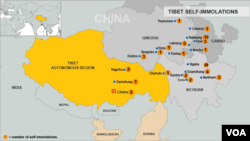
Since 2009, at least 85 Tibetans have set themselves ablaze to protest what they say is Beijing's repression of their culture and religion. Nearly a third (23) of those self-immolations occurred in the past month, as China prepared for its 10-yearly power handover.
Analysts say the Tibetan struggle against Chinese rule may have entered a new phase judging by the recent increase in self-immolation protests.
Robert Barnett of New York's Columbia University told VOA that the self-immolations seem to have become more deliberate in recent weeks.
He says the first phase of self-immolations began last year with monks and nuns trying to protect their monasteries from security crackdowns.
But he notes that the second wave, which occurred for most of the past year, involved individuals in small towns sharing sympathy with those monks and nuns.
"But now in this phase we have laypeople staging these immolations in ways that are much more determined in an attempt to get a response from Chinese authorities, by having immolations in clusters, very close together, many on the same day or within a few days and many in the same place," said Barnett.
James Leibold, a Tibet analyst for Australia's Latrobe University in Beijing, tells VOA that a broader segment of the Tibetan community is also involved in the latest protests.
"We've got the provinces that sort of surround the Tibetan autonomous region all having self-immolations in the last couple months, as well as the diversity of the people involved, in terms of age ranges, in terms of occupations. Both laypeople and monks and nuns [are] involved in these self-immolations. Without a doubt, it's really reaching a crisis point," said Leibold.
Many activists, including Tenzin Dolkar of the advocacy group Students for a Free Tibet, say the increase in self-immolations is aimed at sending a message to China's new leaders that Tibetans will continue their non-violent struggle for freedom.
"It seems Tibetans are really trying to put the Tibet issue on the map for the new Chinese leadership and to make sure Tibet truly becomes the top priority as Xi Jinping and his team take over," said Dolkar.
Some hold out hope that Xi Jinping, who is taking over China's top leadership spot, will be more sympathetic toward the plight of Tibetans, since his late father had a close relationship with the Dalai Lama in the 1950s.
But Leibold says so far there is no indication that the government has changed its position on Tibet.
"Sadly, we hear the same rhetoric coming out of Beijing, and Chinese officials continually blaming a few black hands for collaborating with the Dalai Lama and the exiled Tibetan community to stir up trouble and to damage China's ethnic unity and harmony. There's just absolutely no will, it seems, to admit a failure of policy," he said.
China says Tibetans enjoy full religious freedom and benefit from better living standards linked to Chinese investment in underdeveloped Tibetan regions. Beijing has accused the Dalai Lama of inciting the self-immolations to promote Tibetan separatism, a charge he denies.
A spokesman for the Kirti Monastery in Dharamsala, India, told VOA Tibetan Service that 24-year-old Kalsang Kyab poured kerosene over himself in front of the Kangsa Township government building in Amdo Ngaba area. The spokesman, Kanyag Tsering, quoted witnesses as saying the victim shouted slogans of support for Tibet's exiled spiritual leader, the Dalai Lama, as he was dying.
VOA's Tibetan Service reports that four more Tibetans set themselves on fire Sunday and Monday in Gansu, Sichuan and Qinghai provinces in other self-immolations to hit western China.
Since 2009, at least 85 Tibetans have set themselves ablaze to protest what they say is Beijing's repression of their culture and religion. Nearly a third (23) of those self-immolations occurred in the past month, as China prepared for its 10-yearly power handover.
Analysts say the Tibetan struggle against Chinese rule may have entered a new phase judging by the recent increase in self-immolation protests.
Robert Barnett of New York's Columbia University told VOA that the self-immolations seem to have become more deliberate in recent weeks.
He says the first phase of self-immolations began last year with monks and nuns trying to protect their monasteries from security crackdowns.
But he notes that the second wave, which occurred for most of the past year, involved individuals in small towns sharing sympathy with those monks and nuns.
"But now in this phase we have laypeople staging these immolations in ways that are much more determined in an attempt to get a response from Chinese authorities, by having immolations in clusters, very close together, many on the same day or within a few days and many in the same place," said Barnett.
James Leibold, a Tibet analyst for Australia's Latrobe University in Beijing, tells VOA that a broader segment of the Tibetan community is also involved in the latest protests.
"We've got the provinces that sort of surround the Tibetan autonomous region all having self-immolations in the last couple months, as well as the diversity of the people involved, in terms of age ranges, in terms of occupations. Both laypeople and monks and nuns [are] involved in these self-immolations. Without a doubt, it's really reaching a crisis point," said Leibold.
Many activists, including Tenzin Dolkar of the advocacy group Students for a Free Tibet, say the increase in self-immolations is aimed at sending a message to China's new leaders that Tibetans will continue their non-violent struggle for freedom.
"It seems Tibetans are really trying to put the Tibet issue on the map for the new Chinese leadership and to make sure Tibet truly becomes the top priority as Xi Jinping and his team take over," said Dolkar.
Some hold out hope that Xi Jinping, who is taking over China's top leadership spot, will be more sympathetic toward the plight of Tibetans, since his late father had a close relationship with the Dalai Lama in the 1950s.
But Leibold says so far there is no indication that the government has changed its position on Tibet.
"Sadly, we hear the same rhetoric coming out of Beijing, and Chinese officials continually blaming a few black hands for collaborating with the Dalai Lama and the exiled Tibetan community to stir up trouble and to damage China's ethnic unity and harmony. There's just absolutely no will, it seems, to admit a failure of policy," he said.
China says Tibetans enjoy full religious freedom and benefit from better living standards linked to Chinese investment in underdeveloped Tibetan regions. Beijing has accused the Dalai Lama of inciting the self-immolations to promote Tibetan separatism, a charge he denies.