



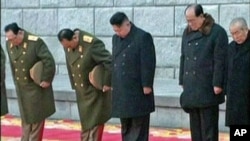
Professional North Korea watchers are closely studying the photos and videos of Kim Jong Il's funeral in search of clues to how the transfer of power to Kim's son, Kim Jong Un, is proceeding.
Their conclusion: So far it seems to be going smoothly.
Scott Snyder, a senior fellow at the Council on Foreign Relations in Washington, pointed out that Wednesday's funeral procession was led by the same people who were identified as North Korea's top leaders at a conference 15 months ago.
"I think it’s important to recognize that, in comparison with the top leadership revealed in September of 2010, the only change that we see in terms of rank, hierarchy in connection with the funeral procession is that Kim Jong Il is absent and Kim Jong Un has moved up to take that role," said Snyder.
Snyder said there still may be rivalries beneath the surface that have yet to appear.
As the limousine carrying Kim Jong Il's casket made its way through Pyongyang's streets Wednesday, Kim Jong Un walked alongside the car's right front fender. Lined up behind him were his uncle and presumed protector, Jang Song Taek, and two other senior ruling party officials, Kim Ki Nam and Choe Thae Bok.
On the left-hand side of the car were four top military officials, led by the armed forces chief of staff, Ri Yong Ho. Behind him were the armed forces minister, Kim Yong Chun, senior officer Kim Jong Gak and another officer whose face was obscured in the photos.
Noticeably missing was Kim Kyong Hui, the sister of Kim Jong Il and wife of Jang Song Taek, who has been elevated to senior positions to help protect her nephew, Kim Jong Un. Analysts say her absence, though, may simply reflect Korean cultural traditions or have been a concession to the cold weather.
The balance between ruling party and military officials suggests to some analysts that the major power structures in North Korea are working together to ensure a smooth succession of power - at least for now.
But Snyder said there is still is potential for future disagreements over such issues as whether to institute Chinese-style economic reforms or stick to Kim Jong Il's policy of "military first."
"I think there are a number of potential issues that could be divisive within this collective leadership. That is certainly one of them. Another one is the relative emphasis on the party versus the military as the major bureaucratic foundation for Kim Jong Un’s rule," said Snyder.
Bruce Klingner, a senior research fellow with the Heritage Foundation in Washington, said that under Kim Jong Il and his father, Kim Il Sung, it did not really matter which organization was ascendant because the national leader was in charge of all of them.
But under Kim Jong Un, he said, organizational differences and priorities likely will be more important.
"Clearly the military is the strongest because it's got the weapons. But as we’ve seen over the years in the Soviet Union and in Eastern European regimes, if the military is seen as getting too strong, then there may be actions taken, either purges or organizational changes to ensure that the other, less well armed parts of the government retain some control," said Klingner.
If the analysts were unable to glean much from Wednesday's ceremony, they soon will get other chances. Snyder said he will be watching closely on January 1, when the North Korean regime traditionally issues a broad policy statement on behalf of its leadership.
More clues may be dropped a week later, when North Korea celebrates the birthday of its new leader, Kim Jong Un.