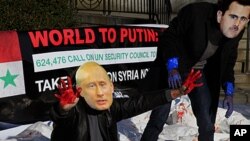
There are concerns in the international community that diplomatic efforts to stop the violence in Syria are failing and that the situation could spiral into all-out civil war, with consequences throughout the region.
Former U.N. Secretary-General Kofi Annan’s peace plan to end the 15-months of bloodshed, which calls for withdrawal of heavy weaponry from urban areas, a ceasefire, and talks between the Syrian government and opposition, is not gaining traction.
Given Russia's strong economic and military ties with Syria, experts say Moscow could be a key player in resolving the crisis.
For decades Moscow has provided economic and military assistance to the Syrian government, including MiG fighter planes and sophisticated air defenses. Russia also maintains a Soviet-era naval facility in the Syrian Mediterranean Sea port of Tartus and plans to modernize the base to accommodate larger warships, including aircraft carriers.
Experts say the Kremlin's close relationship with Damascus has colored Russia’s reaction to the crisis in Syria. Moscow has resisted Western efforts to condemn President Bashar al-Assad since the uprising began, and joined China in vetoing a U.N. Security Council resolution calling for the Syrian leader to step down. U.S. Secretary of State Hillary Clinton called the vote “a travesty.”
Stephen Cohen, professor emeritus at Princeton University and New York University, says Moscow used its veto power because it felt betrayed after abstaining from a Security Council resolution establishing a no-fly zone over Libya in March 2011.
“Russia was told that force will not be used, only the enforcement of a no-fly zone over [Moammar] Gadhafi’s Libya,” says, Cohen, explaining why Moscow then vowed not to take Washington’s word again regarding the use of force. “When American-led NATO went to war against Gadhafi in Libya, Moscow saw that as a broken promise. So when that issue against the Syrian government arose [at the U.N. Security Council] more recently, the Russians vetoed it and it was not surprising. They had Libya on their minds.”
Robert Legvold of Columbia University says Russia's actions at the United Nations have had repercussions throughout the West.
“The Russian position on Syria, as the China position on Syria, has done very serious damage to the relationship with the U.S. and the European Union members," he says, adding that it has “bruised, angered and frustrated” the Obama administration.
Despite its U.N. vetoes, Moscow has endorsed Kofi Annan's peace plan, and experts say Russia has tried to play a mediating role in the conflict, hosting Syrian government officials in Moscow and, separately, members of the opposition.
John Parker of the National Defense University says Moscow could exert pressure on Syria.
“But it doesn’t seem to have been very successful so far,” he says. “If you would really press the Russians, they think that eventually Bashar al-Assad will fall. But they want to slow down the process and keep it from becoming as violent as it has the potential to become.”
Vitaly Churkin, Russia’s ambassador to the United Nations, says the “Syrian situation has a very grave potential of impacting not only Syria in a very bad way, but the region.”
Churkin calls the region “extremely fragile, from Libya to Iran."
"So the prospect of quite dramatic developments - not just in Syria but regionally - is there,” he says, adding that Moscow is dissatisfied with the current state of affairs and will use every opportunity and channel of communication to try to improve the situation.
Former U.N. Secretary-General Kofi Annan’s peace plan to end the 15-months of bloodshed, which calls for withdrawal of heavy weaponry from urban areas, a ceasefire, and talks between the Syrian government and opposition, is not gaining traction.
Given Russia's strong economic and military ties with Syria, experts say Moscow could be a key player in resolving the crisis.
For decades Moscow has provided economic and military assistance to the Syrian government, including MiG fighter planes and sophisticated air defenses. Russia also maintains a Soviet-era naval facility in the Syrian Mediterranean Sea port of Tartus and plans to modernize the base to accommodate larger warships, including aircraft carriers.
Experts say the Kremlin's close relationship with Damascus has colored Russia’s reaction to the crisis in Syria. Moscow has resisted Western efforts to condemn President Bashar al-Assad since the uprising began, and joined China in vetoing a U.N. Security Council resolution calling for the Syrian leader to step down. U.S. Secretary of State Hillary Clinton called the vote “a travesty.”
Stephen Cohen, professor emeritus at Princeton University and New York University, says Moscow used its veto power because it felt betrayed after abstaining from a Security Council resolution establishing a no-fly zone over Libya in March 2011.
“Russia was told that force will not be used, only the enforcement of a no-fly zone over [Moammar] Gadhafi’s Libya,” says, Cohen, explaining why Moscow then vowed not to take Washington’s word again regarding the use of force. “When American-led NATO went to war against Gadhafi in Libya, Moscow saw that as a broken promise. So when that issue against the Syrian government arose [at the U.N. Security Council] more recently, the Russians vetoed it and it was not surprising. They had Libya on their minds.”
Robert Legvold of Columbia University says Russia's actions at the United Nations have had repercussions throughout the West.
“The Russian position on Syria, as the China position on Syria, has done very serious damage to the relationship with the U.S. and the European Union members," he says, adding that it has “bruised, angered and frustrated” the Obama administration.
Despite its U.N. vetoes, Moscow has endorsed Kofi Annan's peace plan, and experts say Russia has tried to play a mediating role in the conflict, hosting Syrian government officials in Moscow and, separately, members of the opposition.
John Parker of the National Defense University says Moscow could exert pressure on Syria.
“But it doesn’t seem to have been very successful so far,” he says. “If you would really press the Russians, they think that eventually Bashar al-Assad will fall. But they want to slow down the process and keep it from becoming as violent as it has the potential to become.”
Vitaly Churkin, Russia’s ambassador to the United Nations, says the “Syrian situation has a very grave potential of impacting not only Syria in a very bad way, but the region.”
Churkin calls the region “extremely fragile, from Libya to Iran."
"So the prospect of quite dramatic developments - not just in Syria but regionally - is there,” he says, adding that Moscow is dissatisfied with the current state of affairs and will use every opportunity and channel of communication to try to improve the situation.