



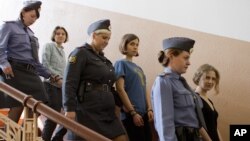
LONDON — Analysts say the "hooliganism" trial in Moscow for three punk musicians who staged a protest in a Russian Orthodox cathedral weakens Russia's freedom of speech and underlines the vast influence in Russia of the Orthodox Church. Three women from a music group they call "Pussy Riot" were found guilty Friday and sentenced to two years in prison for performing a song styled as a prayer for the ouster of President Vladimir Putin. Experts say the case weakens freedom of speech in Russia.
Analysts say this trial and sentencing is proof that the Russian government will continue with attempts to silence political dissent in the future.
James Nixey is an analyst with the Royal Institute for International Affairs, the think-tank known as Chatham House. He offers a definition of free speech-Moscow style.
"Criticism is allowed. However, when it is too widely publicized or when it is too personal, then it is not allowed. When the criticism is of the president himself in particular, when it is of his personal wealth, for example, or corruption aspects, or criminal aspects high up within the regime, then the state begins to crack down. So in other words there are limits," said Nixey.
Nixey says Russia under the leadership of President Putin, a former KGB officer, is veering toward the old Soviet style of governance.
"He's been in power for 13 years now and Russia isn't really changing, insofar as it's not becoming a more pluralistic society," said the analyst. "It's not becoming part of the West and it's in some ways retrenching back into the Soviet Union. It's creating its own structures within that post-Soviet space so it very much fits in with Putin's idea as a Eurasianist, if you like - somebody who believes in the value of the Soviet Union space as a continued area."
Three women from a Russian punk band known as "Pussy Riot" now have been sentenced to two years' imprisonment for a brief anti-Putin protest six months ago on the altar of Moscow's largest orthodox cathedral. The judge who pronounced them guilty, Marina Syrova, said the charge of "hooliganism" was justified because the women "crudely undermined social order" in their protest, which was motivated by religious hatred.
The women say they were trying to illustrate the Russian Orthodox Church hierarchy's strong political support for Putin, who had not yet been re-elected president.
Nixey says the outcome of the case will encourage the Russian government to further prosecute political dissent.
"The extent to which I think some of those opposition leaders' freedom to remain at large will remain is now open to question. It is probable that the current 'Pussy Riot' trial will simply harden the authorities' resolve in believing that they can get away with fairly arbitrary incarcerations of critical individuals," he said.
Susan Larsen, who lectures on Russian culture at the University of Cambridge, thinks Putin's government is trying to tighten its grip on power through an alliance with the Russian Orthodox Church.
"The, what you could call the Putinocracy, has been manipulating the laws in order to maintain its grip on power," she said. "And part of that attempt to maintain a grip on power is through alliance with the Russian Orthodox Church. This is just the visible tip of an iceberg of rapidly increasing repression and clamp-down on many different forms of political activity."
Critics of the punk protesters, however, say their stunt was an insult to the Russian Orthodox Church, and they should have been punished even more harshly.
Larsen contends those sentiments will have little impact inside Russia.
"The trial itself can't have an impact on opinion inside the country until the mass media, mainly the broadcast media, start to report on it in an even-handed way. The country itself is going to mobilize not around freedom of speech but it's going to mobilize around the fight against corruption," she said.
Large crowds of "Pussy Riot" supporters gathered in Moscow for the trial on Friday, and there also were also sympathetic protests in Paris, Belgrade, Berlin, Sofia, London, Dublin and Barcelona, as well as personal statements of support for the women from artists including Paul McCartney and Madonna.
Analysts say this trial and sentencing is proof that the Russian government will continue with attempts to silence political dissent in the future.
James Nixey is an analyst with the Royal Institute for International Affairs, the think-tank known as Chatham House. He offers a definition of free speech-Moscow style.
"Criticism is allowed. However, when it is too widely publicized or when it is too personal, then it is not allowed. When the criticism is of the president himself in particular, when it is of his personal wealth, for example, or corruption aspects, or criminal aspects high up within the regime, then the state begins to crack down. So in other words there are limits," said Nixey.
Nixey says Russia under the leadership of President Putin, a former KGB officer, is veering toward the old Soviet style of governance.
"He's been in power for 13 years now and Russia isn't really changing, insofar as it's not becoming a more pluralistic society," said the analyst. "It's not becoming part of the West and it's in some ways retrenching back into the Soviet Union. It's creating its own structures within that post-Soviet space so it very much fits in with Putin's idea as a Eurasianist, if you like - somebody who believes in the value of the Soviet Union space as a continued area."
Three women from a Russian punk band known as "Pussy Riot" now have been sentenced to two years' imprisonment for a brief anti-Putin protest six months ago on the altar of Moscow's largest orthodox cathedral. The judge who pronounced them guilty, Marina Syrova, said the charge of "hooliganism" was justified because the women "crudely undermined social order" in their protest, which was motivated by religious hatred.
The women say they were trying to illustrate the Russian Orthodox Church hierarchy's strong political support for Putin, who had not yet been re-elected president.
Nixey says the outcome of the case will encourage the Russian government to further prosecute political dissent.
"The extent to which I think some of those opposition leaders' freedom to remain at large will remain is now open to question. It is probable that the current 'Pussy Riot' trial will simply harden the authorities' resolve in believing that they can get away with fairly arbitrary incarcerations of critical individuals," he said.
Susan Larsen, who lectures on Russian culture at the University of Cambridge, thinks Putin's government is trying to tighten its grip on power through an alliance with the Russian Orthodox Church.
"The, what you could call the Putinocracy, has been manipulating the laws in order to maintain its grip on power," she said. "And part of that attempt to maintain a grip on power is through alliance with the Russian Orthodox Church. This is just the visible tip of an iceberg of rapidly increasing repression and clamp-down on many different forms of political activity."
Critics of the punk protesters, however, say their stunt was an insult to the Russian Orthodox Church, and they should have been punished even more harshly.
Larsen contends those sentiments will have little impact inside Russia.
"The trial itself can't have an impact on opinion inside the country until the mass media, mainly the broadcast media, start to report on it in an even-handed way. The country itself is going to mobilize not around freedom of speech but it's going to mobilize around the fight against corruption," she said.
Large crowds of "Pussy Riot" supporters gathered in Moscow for the trial on Friday, and there also were also sympathetic protests in Paris, Belgrade, Berlin, Sofia, London, Dublin and Barcelona, as well as personal statements of support for the women from artists including Paul McCartney and Madonna.