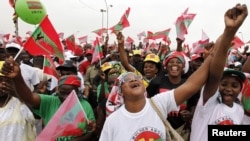
Angola is still waiting for final results of the parliamentary elections, which are likely to be won by the ruling party MPLA and its leader, incumbent president José Manuel Dos Santos. In the meantime, the main historical opposition party, UNITA, is using all legal means to contest the elections. From the battlefield to the ballot box, the party has come a long way to achieve a peaceful resistance.
Sitting on his motorbike, Calupeteca Leonardo Mario, 20, is waiting for customers. In this suburb of Luanda, the young man is a moto-taxi driver. He says life is not easy around here.
Mario says he works twelve hours a day to earn only $20 per day which, given the high cost of life in Luanda, is not enough to live decently. So for its first elections, he decided to vote for the opposition party, the National Union for the Total Independence of Angola, known as UNITA.
Mario says that it is the first time he can vote and as he was growing up, he has always known the UNITA as the main opposition party in Angola. And that is why he voted for them. To him, UNITA, or the newly-created opposition party CASA-SE, are the same, their program does not matter as long as they oppose the ruling party, known as the People's Movement for the Liberation of Angola (MPLA), and its leader, José Eduardo Dos Santos, who has been in power for the last 33 years.
UNITA, according to preliminary results, should get about 17% of the vote. And although the party contests the figures and claims the vote total is higher, it is still almost twice what the party had four years ago, during the first post-war elections.
For journalist and human rights activist Rafael Marques de Morais, the simple fact that UNITA is still around is seen as quite an accomplishment, 10 years after the end of the civil war with the MPLA which lasted for 27 years and ended with the killing of UNITA's founder Jonas Savimbi in 2002.
"Peace was not a priority for UNITA, and ultimately they paid the price of war," he said. "I think UNITA has shown a great ability to survive under the most depressing conditions. After having lost part of its leadership in '92', UNITA was able to rebuild its structure. It has done a remarkable job, in becoming a true civilian party. "
UNITA was created in 1966 by former MPLA member Jonas Savimbi, to fight Portugal, which ruled Angola as a colony. After independence was won in 1975, the liberation parties started to fight each other for power, in a Cold War proxy war, pitting the U.S. backed-UNITA against the MPLA, supported by the former Soviet Union and Cuba. In 2002, the MPLA eventually won by killing Savimbi.
UNITA's spokesperson Alcides Sakala, who was fighting alongside Savimbi back then, remembers the soul-searching the party had to face.
"Doc Savimbi died in combat," said Sakala. "That was really a very difficult moment. Because the party was founded by himself and now, what to do?
"Continuing the resistance in a very difficult condition in a world that was changing then the second option was to take the idea of Doc Savimbi who was willing to negotiate again with the MPLA," he added.
So UNITA decided to become a peaceful political party. Its members elected Isais Samakuva to take over the party leadership, and engaged in the demobilization and re-integration of their army. This transition was not made without trouble, and relations with the ruling party are still difficult.
UNITA claims that the current elections are rigged, but unlike in 1992, elections during which the party rekindled the war, a call for violent action is now definitely off-the-table, says Sakala.
"Now UNITA is a political party," he said. "We don't have any army, we don't have a territory. Ten years have gone ever since the war has finished. Now, our option is to work with the Angolans."
The final elections results are expected to be announced Friday. The ruling MPLA party of President José Eduardo Dos Santos is widely expected to win by a landslide.
Sitting on his motorbike, Calupeteca Leonardo Mario, 20, is waiting for customers. In this suburb of Luanda, the young man is a moto-taxi driver. He says life is not easy around here.
Mario says he works twelve hours a day to earn only $20 per day which, given the high cost of life in Luanda, is not enough to live decently. So for its first elections, he decided to vote for the opposition party, the National Union for the Total Independence of Angola, known as UNITA.
Mario says that it is the first time he can vote and as he was growing up, he has always known the UNITA as the main opposition party in Angola. And that is why he voted for them. To him, UNITA, or the newly-created opposition party CASA-SE, are the same, their program does not matter as long as they oppose the ruling party, known as the People's Movement for the Liberation of Angola (MPLA), and its leader, José Eduardo Dos Santos, who has been in power for the last 33 years.
UNITA, according to preliminary results, should get about 17% of the vote. And although the party contests the figures and claims the vote total is higher, it is still almost twice what the party had four years ago, during the first post-war elections.
For journalist and human rights activist Rafael Marques de Morais, the simple fact that UNITA is still around is seen as quite an accomplishment, 10 years after the end of the civil war with the MPLA which lasted for 27 years and ended with the killing of UNITA's founder Jonas Savimbi in 2002.
"Peace was not a priority for UNITA, and ultimately they paid the price of war," he said. "I think UNITA has shown a great ability to survive under the most depressing conditions. After having lost part of its leadership in '92', UNITA was able to rebuild its structure. It has done a remarkable job, in becoming a true civilian party. "
UNITA was created in 1966 by former MPLA member Jonas Savimbi, to fight Portugal, which ruled Angola as a colony. After independence was won in 1975, the liberation parties started to fight each other for power, in a Cold War proxy war, pitting the U.S. backed-UNITA against the MPLA, supported by the former Soviet Union and Cuba. In 2002, the MPLA eventually won by killing Savimbi.
UNITA's spokesperson Alcides Sakala, who was fighting alongside Savimbi back then, remembers the soul-searching the party had to face.
"Doc Savimbi died in combat," said Sakala. "That was really a very difficult moment. Because the party was founded by himself and now, what to do?
"Continuing the resistance in a very difficult condition in a world that was changing then the second option was to take the idea of Doc Savimbi who was willing to negotiate again with the MPLA," he added.
So UNITA decided to become a peaceful political party. Its members elected Isais Samakuva to take over the party leadership, and engaged in the demobilization and re-integration of their army. This transition was not made without trouble, and relations with the ruling party are still difficult.
UNITA claims that the current elections are rigged, but unlike in 1992, elections during which the party rekindled the war, a call for violent action is now definitely off-the-table, says Sakala.
"Now UNITA is a political party," he said. "We don't have any army, we don't have a territory. Ten years have gone ever since the war has finished. Now, our option is to work with the Angolans."
The final elections results are expected to be announced Friday. The ruling MPLA party of President José Eduardo Dos Santos is widely expected to win by a landslide.