
News / Asia

Anti-Japan Protests Held Across China

Protesters overturn a Japanese-brand police car during an anti-Japan protest in Shenzhen, Guangdong province, August 19, 2012.Protesters overturn a Japanese-brand police car during an anti-Japan protest in Shenzhen, Guangdong province, August 19, 2012.
x
Protesters overturn a Japanese-brand police car during an anti-Japan protest in Shenzhen, Guangdong province, August 19, 2012.
TEXT SIZE - +
VOA News
Anti-Japanese demonstrations spread to more than 20 cities in China Sunday, as Tokyo dismissed China's opposition to Japanese activists landing on disputed islands in East China Sea.
 
Chinese demonstrators waved national flags and chanted angry slogans as they protested the arrest of Chinese activists who landed last week in the islands known as Senkaku in Japan and as Diaoyu in China.  In some cities, protesters vandalized Japanese made vehicles and clashed with police who tried to restrain them.
 
Earlier Sunday, a group of 10 Japanese activists, including local lawmakers, swam ashore and unfurled Japanese flags on one of the disputed islands after a flotilla carrying about 150 people sailed to the disputed archipelago.
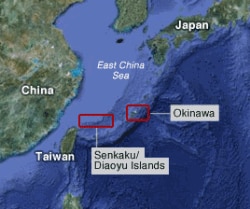
The Chinese foreign ministry issued a "strong protest against the landing.  Japanese Ambassador to China Uichiro Niwa rejected the protest and urged Beijing to protect Japanese property in Chinese cities from vandalism.
 
Both China and Japan claim sovereignty over the uninhabited islands in an area potentially rich in natural resources.
 
Taiwan also claims the maritime territory and its foreign ministry protested the Japanese activists landing on Sunday.
 
Japanese authorities have deported 14 residents of Hong Kong and mainland China who were arrested after traveling to one of the islands last week and planting a Chinese flag there while singing China's national anthem.
 
The disputed islands were administered by the United States from the end of World War Two until they were transferred back to Japan in 1972.  In addition to being located in an area thought to have large reserves of natural gas, the islands are also a source of national pride in both Japan and China.

You May Like

Karzai to Discuss Enhancing Defense Ties with India

Afghanistan looking for more military aid as it prepares for withdrawal of NATO forces by next year More

India, China Pledge to Overcome Border Tensions

Indian prime minister and Chinese premier attempt to move past tense standoff in the Himalayas during Delhi talks More

Burmese President Opens US Visit with VOA Town Hall Meeting

Ahead of his meeting with President Obama Monday, Thein Sein answered questions on human rights and economic development in his country More

This forum has been closed.
Comment Sorting
Comments page of 2
    Next 
by: Hoang from: Canada
August 21, 2012 4:56 PM
These islands belong to Japan and given back to Japan by the U.S. after world war 2. China, don't distort history and make trouble. Japan is not corrupt like Communist Vietnam and is capable of teaching you savages Chinese a lesson.


by: Anonymous
August 20, 2012 2:33 PM
Please do not change the key point. It's NOT the problem of resources, it's the problem of national and regional security! The island's sovereign rights belongs to CHINA the whole history and how could China give out that strategic point that is so near that can attack China directly.


by: Anonymous
August 20, 2012 8:31 AM
From pictures shown from other media sources, the (illegal) activists carried or was planting three Chinese flags there while singing PRC-China's national anthem. The three flags belongs two different regimes all claim to have the legitimate sovereignty over 'China' in addition to Senkaku islands.


by: Anonymous
August 20, 2012 7:20 AM
why not say it is the US who sent the island to japan at the end of the second war!


by: hang_gwen_pots from: NZ
August 20, 2012 5:45 AM
Don't forget the fact that the current dispute was triggered by the governor of Tokyo, Shintaro Ishihara's plan to buy the islands.
Shintaro Ishihara
http://en.wikipedia.org/wiki/Shintaro_Ishihara


by: Chinese Man
August 20, 2012 5:10 AM
The US will regret for what it had done soon.


by: Yoshi from: Sapporo
August 20, 2012 1:45 AM
Whenever I watch the style of demonstaration of both Chinese and Korean people, I always feel reuactant because they often fire national flags and destroy goods made in opposit countries. As noted in this article, those actions are nothing but vandalaization at all. I hope Chiana and Korean people should notice that these kind of behavior are no longer efficient to persuade not only oppositions but also international opinions of their claim.  


by: riano baggy from: ina
August 20, 2012 1:35 AM
now samurai and sword have high tension,maybe this conflict goes to international law, maybe UN handle this islands and operated this natural resources and this revenues divided 3 (UN,japan,china).


by: Samuai from: Japan
August 20, 2012 12:54 AM
Just imagine! A gangster intentionally picks a quarrel with a good man on the street. He demands money or valuables. Then, he destructs the properties of the good man, if the good man ignores the gangster's illegal and lawless demand. Compare what Chinese are now doing against Japanese restaurants or even vehicles made in Japan with what the gangster does. Who can teach Chinese how to learn laws or at least ethics and manners? During the latter part of the Cultural Revolution (in fact, just purge), Chinese were prohibited from respecting manners and ethics, as bourgeois' practices. No need to say any more!!! If China wants gas and natural resources of other countries, they have to pay money therefor.


by: Anonymous
August 19, 2012 11:06 PM
The thing that not mentioned is the 150 rightwing Japenese also prayed for the soul of WWII crimes during they ashore the disputed island. That disgust thing is one of the dominating reasons caused the china anti-Japan demonstration.

Comments page of 2
    Next 

Featured Videos

Your JavaScript is turned off or you have an old version of Adobe's Flash Player. Get the latest Flash player.
Video

Video Valley Fever Raises Concerns in California, Arizona

A longstanding health problem in California's Central Valley has worsened in recent years, leading health officials to order the relocation of 3,000 prisoners from two state prisons. But the disease affects much of the population in some rural communities and, Mike O'Sullivan reports, while it often goes unnoticed, it sometimes can be devastating for patients.