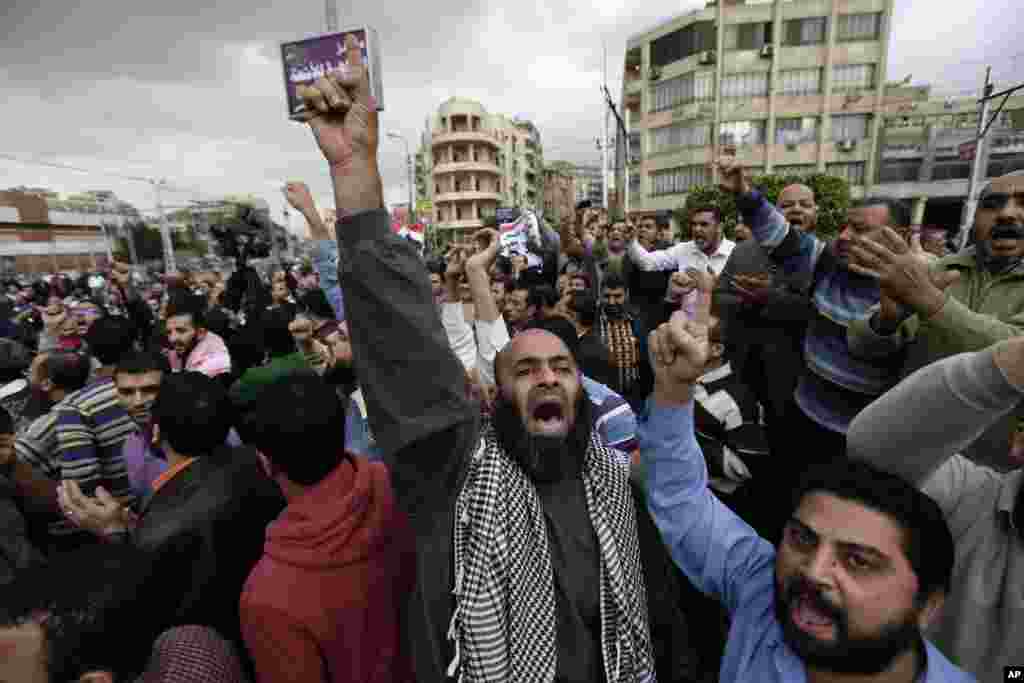
Egyptian protesters chant anti-Muslim Brotherhood slogans during a rally in front of the presidential palace, in Cairo, Egypt, Dec. 4, 2012.
CAIRO —
Demonstrators in Egypt gathered Tuesday in a march on the presidential palace to protest against President Mohamed Morsi and an upcoming referendum on the constitution. News outlets are also protesting what they consider as a clampdown on press freedoms.
Leaders of the protest, including former presidential candidates Amr Moussa, Hamdeen Sebahi and Mohamed ElBaradei dubbed it a “final warning” to Morsi to withdraw the draft constitution. The draft law was hastily approved Friday by a committee from which secular, leftist and Christian members had withdrawn.
Moussa, who was leading one of three protest marches, said that pushing through the draft constitution, scheduled for a referendum on December 15, was “inflaming public opinion.” He said disagreements over the text need to be resolved first.
Moussa said there remains major disagreements over the text of the constitution on various issues, and that members pulled out of the drafting committee because there had not been adequate discussion.
Egypt Protests Continue
1/13Supporters of Egyptian President Mohammed Morsi chant slogans during a demonstration outside the presidential palace, in Cairo, Egypt, Dec. 5, 2012.
Supporters and opponents of Egyptian President Mohamed Morsi took to the streets of Cairo in several demonstrations Tuesday and Wednesday. The protests started more than one week ago.
Show moreShow less
2/13A supporter of Egyptian President Mohammed Morsi chants slogans during clashes with opponents, not pictured, outside the presidential palace, in Cairo, Egypt, Dec. 5, 2012.
Supporters and opponents of Egyptian President Mohamed Morsi took to the streets of Cairo in several demonstrations Tuesday and Wednesday. The protests started more than one week ago.
Show moreShow less
3/13Egyptian President Mohammed Morsi’s supporters beat an opponent, center, during clashes outside the presidential palace, in Cairo, Egypt, Dec. 5, 2012.
Supporters and opponents of Egyptian President Mohamed Morsi took to the streets of Cairo in several demonstrations Tuesday and Wednesday. The protests started more than one week ago.
Show moreShow less
4/13Egyptian President Mohammed Morsi’s supporters clash with opponents, not pictured, outside the presidential palace, in Cairo, Egypt, Dec. 5, 2012.
Supporters and opponents of Egyptian President Mohamed Morsi took to the streets of Cairo in several demonstrations Tuesday and Wednesday. The protests started more than one week ago.
Show moreShow less
5/13Egyptian protesters chant anti-Muslim Brotherhood slogans during a demonstration outside the presidential palace, in Cairo, Egypt, Dec. 5, 2012.
Supporters and opponents of Egyptian President Mohamed Morsi took to the streets of Cairo in several demonstrations Tuesday and Wednesday. The protests started more than one week ago.
Show moreShow less
6/13An Egyptian protester with Arabic writing on his forehead that reads, "Muslims and Christians, one hand," attends a demonstration outside the presidential palace, in Cairo, Egypt, Dec. 5, 2012.
Supporters and opponents of Egyptian President Mohamed Morsi took to the streets of Cairo in several demonstrations Tuesday and Wednesday. The protests started more than one week ago.
Show moreShow less
7/13A young boy waves a national flag from his mother's shoulders as protesters chant slogans in Tahrir Square in Cairo, Egypt, December 4, 2012.
Supporters and opponents of Egyptian President Mohamed Morsi took to the streets of Cairo in several demonstrations Tuesday and Wednesday. The protests started more than one week ago.
Show moreShow less
8/13Anti-Morsi protesters run from smoke from a tear gas canister thrown by riot police, during clashes in front of the presidential palace in Cairo, Egypt, December 4, 2012.
Supporters and opponents of Egyptian President Mohamed Morsi took to the streets of Cairo in several demonstrations Tuesday and Wednesday. The protests started more than one week ago.
Show moreShow less
9/13Protesters chant slogans and wave national flags in Tahrir Square in Cairo, Egypt, December 4, 2012.
Supporters and opponents of Egyptian President Mohamed Morsi took to the streets of Cairo in several demonstrations Tuesday and Wednesday. The protests started more than one week ago.
Show moreShow less
10/13Activists wave an old Soviet and Russian national flags in front of a barricade at the regional administration building, in Donetsk, Ukraine.
Supporters and opponents of Egyptian President Mohamed Morsi took to the streets of Cairo in several demonstrations Tuesday and Wednesday. The protests started more than one week ago.
Show moreShow less
11/13Protesters chant anti-Muslim Brotherhood slogans during a rally in front of the presidential palace, in Cairo, Egypt, December 4, 2012.
Supporters and opponents of Egyptian President Mohamed Morsi took to the streets of Cairo in several demonstrations Tuesday and Wednesday. The protests started more than one week ago.
Show moreShow less
12/13Protesters chant anti-Muslim Brotherhood slogans during a rally in front of the presidential palace, in Cairo, Egypt, December 4, 2012.
Supporters and opponents of Egyptian President Mohamed Morsi took to the streets of Cairo in several demonstrations Tuesday and Wednesday. The protests started more than one week ago.
Show moreShow less
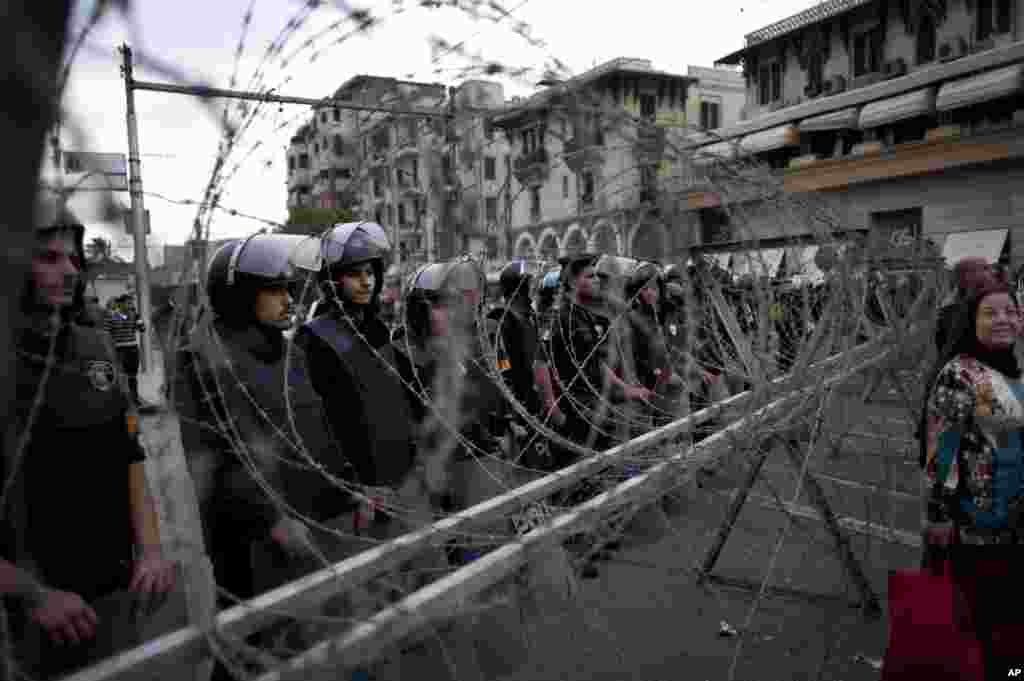
13/13Riot police stand guard behind barbed wire while protesters chant anti Muslim Brotherhood slogans during a demonstration in front of the presidential palace, in Cairo, Egypt, December 4, 2012.
Supporters and opponents of Egyptian President Mohamed Morsi took to the streets of Cairo in several demonstrations Tuesday and Wednesday. The protests started more than one week ago.
Show moreShow less
Previous slide
Next slide
Ahmad al-Zind, the head of Egypt's Judges Club, which represents judges across the country, told a press conference Tuesday that the judiciary was “under fire” by the president's decision to ignore a judicial strike by the country's top courts. He accused the president of trying to “divide the judiciary.”
In addition to the popular demonstrations, 11 Egyptian newspapers suspended publication on Tuesday to protest the new constitution and clauses they say restrict freedom of expression. Top papers ran a sidebar entitled “No to Dictatorship” in their editions Monday.
Veteran Egyptian editor and publisher Hisham Kassem says that no matter what the result of the December 15 referendum, the constitution will ultimately be thrown out by the judiciary.
"There's no way this constitution is going to go through. Even if [Morsi] manages to get it passed on the 15th through a referendum, it's null and void. It's a primitive piece of legislation," he said. "It's becoming clear from jurists comments that this is basically a constitution that will take us back 1000 years or so."
Islamist writer and columnist Fahmy Howeidy, however, says that the crowds of protesters opposing the president and the new constitution are not representative of the Egyptian public.
"If you read the situation now in Cairo through the newspapers... they do not reflect the real feeling in the society," Howeidy said. "For many reasons, now, the papers are reflecting some political fanatic groups, but not the real feeling in the whole society."
Howeidy said that the majority of Egyptians support Morsi and the new constitution.
Vice President Mahmoud Mekki said in a television interview Tuesday that 75 percent of Egyptians support the new constitution.
Kassem says that only about 52 percent of Egyptians voted for Morsi in the June election, and that it was “unlikely that he has more support than that, and probable that he has considerably less [support].”