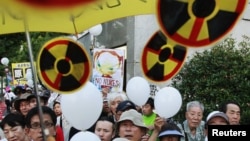
TOKYO — Japan's prime minister -- as well as his predecessor who was in charge of the government during the Fukushima nuclear reactor meltdowns -- met Wednesday with activists who have been organizing weekly protests in front of the prime minister's office. The encounter comes amid reports the government is considering phasing out all nuclear power reactors by the year 2030.
Restarting power reactors
Japanese Prime Minister Yoshihiko Noda, meeting anti-nuclear activists face-to-face for the first time, told them he recently decided to restart two power reactors to protect peoples' livelihoods.
Noda says he made the decision from a comprehensive perspective but will continue to make every effort to ensure reactors coming back online are operating safely.
The country temporarily shut down all of its nuclear power reactors after a huge earthquake and tsunami struck on March 11, 2011.
Also attending the meeting: Naoto Kan who was prime minister when three reactors in Fukushima suffered core meltdowns in last year's disaster.
Activist protest re-start
The attending members of the Metropolitan Coalition Against Nukes told the politicians their group opposes any reactor re-starts.
The grassroots organization has been organizing Friday evening protests in front of the prime minister's office, drawing tens of thousands of people.
A separate group has announced the launch of a nationwide campaign to pass legislation to abolish all nuclear power plants in the country on safety grounds.
One of its leaders, Nobel literature laureate Kenzaburo Oe, terms their quest critical for mankind.
Oe says nuclear power is against basic ethics so all reactors should be shut down immediately.
That is not going to happen. But to the surprise of many on both sides of the debate Japan's government is seriously looking at a phase-out of existing reactors by the year 2030.
The government is expected to announce its intentions next month ahead of parliamentary general elections, which are likely to be held before the end of the year.
Potential drawbacks to closure
Japan's largest circulation daily newspaper, in an editorial, chastised officials as irresponsible for considering the elimination of nuclear power.
The Yomiuri Shimbun says such an “extremely dangerous” energy policy would cause electricity bills to double, destroying Japan's steel industry. Unemployment would swell and the country's gross domestic product would plunge by about $650 billion.
The conservative newspaper also notes Japan is still promoting nuclear power abroad with Japanese companies recently winning tentative bids to construct reactors in Vietnam.
Restarting power reactors
Japanese Prime Minister Yoshihiko Noda, meeting anti-nuclear activists face-to-face for the first time, told them he recently decided to restart two power reactors to protect peoples' livelihoods.
Noda says he made the decision from a comprehensive perspective but will continue to make every effort to ensure reactors coming back online are operating safely.
The country temporarily shut down all of its nuclear power reactors after a huge earthquake and tsunami struck on March 11, 2011.
Also attending the meeting: Naoto Kan who was prime minister when three reactors in Fukushima suffered core meltdowns in last year's disaster.
Activist protest re-start
The attending members of the Metropolitan Coalition Against Nukes told the politicians their group opposes any reactor re-starts.
The grassroots organization has been organizing Friday evening protests in front of the prime minister's office, drawing tens of thousands of people.
A separate group has announced the launch of a nationwide campaign to pass legislation to abolish all nuclear power plants in the country on safety grounds.
One of its leaders, Nobel literature laureate Kenzaburo Oe, terms their quest critical for mankind.
Oe says nuclear power is against basic ethics so all reactors should be shut down immediately.
That is not going to happen. But to the surprise of many on both sides of the debate Japan's government is seriously looking at a phase-out of existing reactors by the year 2030.
The government is expected to announce its intentions next month ahead of parliamentary general elections, which are likely to be held before the end of the year.
Potential drawbacks to closure
Japan's largest circulation daily newspaper, in an editorial, chastised officials as irresponsible for considering the elimination of nuclear power.
The Yomiuri Shimbun says such an “extremely dangerous” energy policy would cause electricity bills to double, destroying Japan's steel industry. Unemployment would swell and the country's gross domestic product would plunge by about $650 billion.
The conservative newspaper also notes Japan is still promoting nuclear power abroad with Japanese companies recently winning tentative bids to construct reactors in Vietnam.