


News / Middle East

    Yemen's Capital Sees Heaviest Airstrikes Since Truce Expired

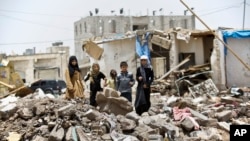
    A boy and his sisters watch graffiti artists spray on a wall, commemorating the victims who were killed in Saudi-led coalition airstrikes in Sana'a, Yemen, May 18, 2015.
    A boy and his sisters watch graffiti artists spray on a wall, commemorating the victims who were killed in Saudi-led coalition airstrikes in Sana'a, Yemen, May 18, 2015.
    Associated Press

    The Saudi-led coalition on Tuesday carried out the heaviest airstrikes near the Yemeni capital since a five-day truce with Yemen's Shiite rebels expired earlier this week, hitting weapons depots in the mountains surrounding Sanaa and sending dozens of families fleeing their homes in panic.
     
    The bombardment began shortly after midnight Monday, with airstrikes targeting rebel-held military depots in the mountains of Fag Atan and Noqom, where missiles, tanks and artillery are kept, the residents said.
     
    The Saudi-led coalition has repeatedly struck the two sites since launching the air campaign against the Iranian-backed rebels, known as Houthis, on March 26. But Tuesday's assault was the heaviest since Sunday's expiration of a five-day humanitarian truce, which was repeatedly violated.
     
    By sunset, a fresh wave of airstrikes sent fire and smoke rising from the mountains around the capital, Sanaa. Dozens of families living close to the bombed sites hurriedly loaded their belongings onto vehicles and left in search of safer areas.
     
    Elsewhere in Yemen, missiles hit several Houthi positions in their strongholds in the northern provinces of Saada and Hajjah, as well as a gathering of fighters allied with the Houthis in the city of Ibb, south of Sanaa. The rebels and their allies were also hit in the western city of Taiz and the southern city of Aden, near its airport, as well as in the eastern province of Marib.  
     
    Airstrikes also targeted a house owned by ousted President Ali Abdullah Saleh in the Sanaa suburb of Sanhan, flattening it. Saleh's whereabouts are not known but his loyalists within the country's fragmented army have joined ranks with the Houthis. That alliance paved the way for the rebel takeover of Sanaa last September and boosted the rebels' ability to advance into southern cities in an effort to expand their territorial gains.
     
    Fearing more airstrikes, residents in areas around Saleh's other houses - such as in Sanaa's al-Dajaj district - packed up and left in search of safer places. Since the rebel power grab started, most of Saleh's homes have been occupied by Houthi leaders.
     
    "Our house is just next to Saleh's house and most of the people have left. Now the district is like a ghost city," said Fathi al-Udini who also left with his family, fleeing al-Dajaj.
     
    In response to the latest airstrikes, the Houthis fired Katyusha rockets at the Saudi border region of Najran from their stronghold of Saada on Tuesday, according to tribesmen in the region. Nearby, the adjacent border area of al-Jouf province saw heavy clashes between Houthi fighters and tribesmen widely believed to be backed and armed by Saudi Arabia. The battles are meant to open a new frontline with Saada to distract the Houthis from shelling Saudi territories, the tribesmen said.
     
    Late Monday, the rebels also continued to blow up homes belonging to rival politicians and security commanders in Yemen. In the latest in a string of detonations, the Houthis blew up the house of the newly appointed Chief of Staff Mohammed al-Maqdisi in the southwestern city of Dhamar, officials said.
     
    The ground fighting did not stop even during the truce between the Houthis and fighters backing internationally-recognized President Abed-Rabbo Mansour Hadi, now in exile in the Saudi capital of Riyadh.
     
    Houthis and their allies have for weeks been trying to take over Aden, the strategic port city on the Arabian Sea, and the truce has apparently given them time to deploy more troops for that purpose.
     
    A senior military commander in Aden said the rebels and their allies have surrounded the city from three different sides over the past weeks and are now in control of several large sections of Aden. Tens of thousands of civilians have been displaced from the area and pro-Hadi fighters have been given three days to surrender their weapons, he added.
     
    The residents, tribesmen, the commander and all Yemeni officials spoke to The Associated Press on condition of anonymity, fearing reprisals by the Houthis.
     
    The Yemeni conflict has killed 1,820 people and wounded 7,330 since March 19, according to UN estimates. The estimates also show that nearly a half million people at least have been displaced in the period since the beginning of the fighting until May 7.
     
    In a show of support to the Saudi-led operation, a gathering of dozens of Yemeni politicians and tribal figures ended in Riyadh on Tuesday with a declaration that called for the formation of special forces to protect Yemen's cities engulfed in the fighting.
     
    The declaration also called for the formation of "safe zones" where "legitimate" Yemeni institutions could operate, though it gave no clear plan on how to set up such special forces or who would be responsible for the safe zones.
     
    When they started on March 26, it was widely believed that the Saudi-led airstrikes would be followed by ground troops. However, almost two months into the campaign, there has been no sign of imminent deployment of ground forces.

    You May Like

    Video Report: Boko Haram Using More Child Suicide Bombers

    Militant group is increasingly using children -- nearly three-quarters have been school-aged girls -- to carry out suicide bombings, UNICEF reports

    Video Viral Ad Sparks Outpouring for 'Leftover Women' in China

    Clip uncovers deep-rooted discrimination against single women, Chinese government’s inaction in tackling gender inequity issues, analysts say

    Why Asian Americans Are the Most Educated Group in America

    More than half of Asians in the United States, 54 percent, have at least a bachelor’s degree

    Featured Videos

    Your JavaScript is turned off or you have an old version of Adobe's Flash Player. Get the latest Flash player.
    Ivory Coast’s All-Female Band Breaks Social Barriersi
    X
    Emilie Iob
    April 11, 2016 1:40 PM
    For nine young female musicians in Ivory Coast, breaking into the male-dominated music industry wasn’t easy. But their group, Bella Mondo, is now a household name in Abidjan and is booking shows abroad. Emilie Iob has more for VOA from Abidjan.
    Video

    Video Ivory Coast’s All-Female Band Breaks Social Barriers

    For nine young female musicians in Ivory Coast, breaking into the male-dominated music industry wasn’t easy. But their group, Bella Mondo, is now a household name in Abidjan and is booking shows abroad. Emilie Iob has more for VOA from Abidjan.
    Video

    Video DC Volunteers Build Affordable Housing

    It is National Volunteer Week in the United States, a time when Americans are donating their time to help make their communities better. The work can be challenging as well as time-consuming. But for these volunteers, it's a labor of love as they build homes for low-income residents in Washington, D.C.'s expensive housing market.
    Video

    Video Spotlight Falls on London as British PM Admits to Profits From Offshore Firm

    British Prime Minister David Cameron has admitted that he had profited from a so-called "shell" company set up by his late father. This follows revelations about the scale of offshore wealth exposed by a leak from a Panama-based law firm earlier this week. But it’s Britain’s wider role in the system of offshore finance that is coming under greater scrutiny - as Henry Ridgwell reports from London.
    Video

    Video Phnom Penh Transforming Overnight with Foreign Investment

    Foreign investors are rushing into Cambodia's frontier property market. Phnom Penh is rising upward almost overnight, but the rate of construction is raising questions about where all the investment is coming from and what effect it will have on the local market. David Boyle reports from the Cambodian capital.
    Video

    Video Panama Tax Haven Revelations Show How Neediest Nations Are Harmed

    The Panama Papers — documents leaked from a Panamanian law firm — reveal a shady side to the global financial system, in which the world’s elite routinely hide money to remain anonymous or to avoid paying taxes. While some argue there’s nothing illegal about the practice, others say the lack of transparency and controls in many tax haven countries comes with a heavy price tag, especially in countries where development money is needed most. VOA's Mil Arcega reports.
    Video

    Video Soap-making Factories Bring Economic Relief to Syrian Town

    War in Syria, now in its fifth year, has adversely affected businesses and local industries. But in one district of the country, the soap-making industry is trying to get back on its feet and providing much-needed employment opportunities to the local population. With Robert Raffaele narrating, VOA’s Amina Misto reports.
    Video

    Video Stranded in Greece, Afghan Interpreters Feel Abandoned By US, Coalition

    Among the tens of thousands of refugees stranded in Greece are many Afghan nationals -- including some who tell VOA they were forced to flee threats from the Taliban because they had worked with US and coalition forces. The United States has a special visa to help Afghans and Iraqis who worked with the US military to gain asylum -- but the refugees say the system takes far too long, and they had to flee for their lives. Henry Ridgwell reports from Athens.
    Video

    Video Experts: IS Looting Antiquities on Industrial Scale

    Experts say the Islamic State is looting and selling cultural antiquities from Iraq and Syria on an industrial scale. The destruction and sale of these treasures is not only condoned but has been institutionalized within the Islamic State itself. And as Jeff Swicord reports, artifacts are beginning to show up on antiquities markets around the world.
    Video

    Video Deportations Bring Unease to Turkey

    Turkey is expecting to receive 200 more migrants deported from Greece on Friday. It is part of the deal reached in March between the European Union and Ankara to alleviate Europe’s migrant crisis. But there is also nervousness among some Turks who question whether their country can and should absorb the refugees who do not return to their nations of origin. VOA Europe Correspondent Luis Ramirez reports.
    Video

    Video Scientists Creating New Devices to Battle Diabetes

    Diabetes is fast becoming a major global problem, affecting 422 million people. But nanotechnology may someday make monitoring blood glucose levels and administering medicine much simpler than it is today. VOA’s George Putic reports.

    Special Report

    Adrift The Invisible African Diaspora