


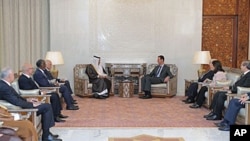
The Arab League's point-man for Syria, Qatar's foreign minister, says the league is waiting for a Syrian response to a demand that Damascus pull its tanks off the streets and start negotiations with the opposition.
Syrian security forces stormed a university campus in the southern flashpoint city of Daraa Monday, firing on students and making arrests. Military operations were also reported across scattered parts of northern Syria, as diplomats awaited Damascus' official response to Arab League demands that it stop attacking civilians and begin a dialogue with the opposition.
Arab League chief Nabil Elarabi told the French news agency that Syria was being asked to “withdraw tanks and all military vehicles, to put an immediate end to violence, and to reassure its people.” Elarabi added that Syria must also begin talks with the opposition in Cairo.
However, Syrian President Bashar al-Assad said in an interview carried on state television that his government requires a valid partner in order to enter into any dialogue:
He says a dialogue always requires two parties, and not just one. He also warns that the parties that participate must be acceptable to the Syrian people, claiming that no dialogue can be held with parties that have ties with foreign powers or ties to what he calls terrorism.
Qatar's Foreign Minister Hamad Bin Jassem Bin Jaber Al Thani gave Damascus a thinly veiled warning, insisting that reform is necessary if outside intervention of the sort which occurred in Libya is to be avoided:
He says a big tempest is shaking the entire region, and Arab leaders must learn to deal with it properly, without pretending, skirting the issues or employing fraud. Reforms are needed, he says, so as to avoid the sorts of problems which occurred in certain countries where change was difficult, destruction widespread, and many sacrifices were made.
Analyst Peter Harling of the Crisis Group predicts the Syrian opposition will start a process of militarization if the prospects for a peaceful solution evaporate:
"I think that the temptation now is to resort to weapons, and in particular if the protesters come to the conclusion that the international community is either powerless or inclined to sacrifice the Syrian people in the name regional stability," said Harling. "So, if nothing comes of this initiative, I think we'll see a shift in dynamics on the ground towards militarization of the protest movement.”
Harling adds that the Syrian government continues to depict the protest movement as “provincial, Islamist and sectarian,” calling it a “Sunni Muslim and underclass” phenomenon, so the authorities can "rally support from the middle and upper classes and the urban elite in Damascus and Aleppo.”
Meanwhile, an official conference was convened in Damascus Monday to revamp the constitution. Syrian state television said the meeting was the result of a decree by President Assad last August. The television also broadcast parts of a two-day economic reform conference.