



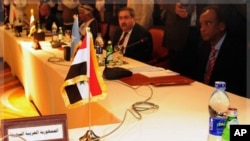
Arab League foreign ministers, meeting in Cairo, agreed Sunday to impose a series of biting economic sanctions on Syria, after Damascus failed to accept an Arab plan to send monitors in response to its deadly crackdown on an opposition uprising. The ministers will meet again next Saturday to review the effects of their action.
Nineteen of 22 Arab League foreign ministers voted to impose the sanctions on Syria. It was an extraordinary action against a member state.
The sanctions include a freeze on the assets of Syrian leaders in Arab states, an end to Arab investment and trade with Syria, a halt to dealings with Syria's central bank, and a ban on travel by Syrian officials to Arab states.
The Arab League's point-man for Syria, Qatari Foreign Minister Hamad bin Jassem bin Jaber al Thani, said the vote to impose sanctions will have its desired effect, even if the sanctions are never applied, so long as Syria ultimately agrees to stop targeting civilians:
Arab foreign ministers will hold a follow-up meeting in one week to re-evaluate the effects of the sanctions and whether they need to be prolonged.
Observers say that Syria could still decide to agree to the Arab League plan within the coming week to have sanctions lifted.
Sheikh Hamad expressed frustration over the long political discussions, stressing that the Arab League could “keep discussing the matter for another year, and issuing new decrees,” but that “the Syrian people would continue to die.”
Arab League head Nabil al Arabi told journalists that extra care would be taken to see that the new economic sanctions would not hurt the Syrian people or neighboring states:
The Syrian economy is already reeling from the convulsions of the eight-month old popular uprising, along with economic sanctions imposed by the European Union and the United States.
Al Arabiya TV reported that the league's decision to freeze the assets of Syrian officials in the Gulf states is the sanction mostly likely to pressure Damascus. Syrian leaders reportedly have few assets in either Europe or the U.S., but large sums invested in the Gulf.