


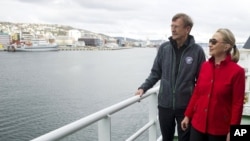
TROMSO, Norway - Thinning polar ice means more sea traffic through the Arctic at a time of territorial claims to an area that could contain as much as 20 percent of the world's undiscovered oil and natural gas reserves. U.S. Secretary of State Hillary Clinton met with Norwegian officials to discuss the changing Arctic.
Over the last 20 years, Norwegian climate scientists say the Arctic has been losing 45,000 square kilometers of ice cover a year. That has opened new shipping routes across the north that could make trade between Europe and Asia 40 percent faster than using the Suez Canal.
So Arctic nations are working to protect a region that Norwegian Foreign Minister Jonas Gahr Stoere says is undergoing a profound transformation.
"There are changes going on which are leading to the emergence of a region which used to be frozen both politically and climatically, and now there is a thaw," Stoere said.
The foreign minister brought Secretary Clinton to this city above the Arctic Circle to meet with scientists and business leaders preparing for greater ocean traffic and greater oil exploration in a region that the U.S. Geologic Survey says could hold $9 trillion in oil and minerals.
"A lot of countries are looking at what will be the potential for exploration and extraction of natural resources as well as new sea lanes and are increasingly expressing an interest in the Arctic," Clinton noted. "The United States and Norway are committed to promoting responsible management of those resources and to do all we can to prevent and mitigate the effects of climate change."
Warmer waters and receding ice mean big changes for animals at the top of the Arctic food chain including polar bears and seals.
"In the fjords of Svalbard we used to have a lot of ice and this was a good denning area for the seals. It is also a good feeding area for polar bears. Now there is no ice," explained Geir Wing Gabrielsen, who directs ecotoxicology programs at the Norwegian Polar Institute. "That means that these seals have to find other areas to have the young ones. The polar bears, they don't find the food they used to find in this area."
Higher ocean acid levels also have an impact lower down the food chain as crustaceans such as the Arctic Sea butterfly form weaker shells. That means less food for herring and cod.
"We see the effect of pollutants on these animals. Which is the result of transport of pollutants from industrial areas, from Central Europe, from North America, Asia, Russia. And this is ending up in the Arctic in the food chain," Gabrielsen said.
Gunhild Hoogensen Gjorv is a political science professor at the University of Tromso.
"The environment here is quite pristine. It's something very important to protect. And what happens in the environment here has global consequences. And we know that," he warned.
Mitigating those consequences falls mainly to the five nations with Arctic coastlines: Canada, Greenland, Norway, Russia, and the United States. Each has an exclusive economic zone within 200 nautical miles of its coast and is dividing the remaining ice around the North Pole through the U.N. Continental Shelf Commission.
Territorial waters are governed by a Treaty of the Sea, to which all of the Arctic nations are a signatory except the United States. Some conservative members of Congress oppose the treaty because they say it unduly restricts the U.S. Navy.
Secretary Clinton told Norwegian officials that the Obama administration is pushing hard for passage of the Treaty of the Sea. Political Science professor Gjorv says it is an important part of moving forward in the Arctic.
"It is going to make it harder for these different actors to come to the table after a while if they feel that there isn't reciprocity coming from the United States with regards to that very important document," Gjorv noted, "particularly as it opens up and we are going to have more activity up here. This is clearly going to be causing strains because we need that as a platform to build on further negotiations on things we have not yet foreseen."
On this trip, Secretary Clinton says she learned that many of the predictions about warming in the Arctic are being surpassed by the actual data, something she says that is not necessarily surprising but is certainly sobering.
Over the last 20 years, Norwegian climate scientists say the Arctic has been losing 45,000 square kilometers of ice cover a year. That has opened new shipping routes across the north that could make trade between Europe and Asia 40 percent faster than using the Suez Canal.
So Arctic nations are working to protect a region that Norwegian Foreign Minister Jonas Gahr Stoere says is undergoing a profound transformation.
"There are changes going on which are leading to the emergence of a region which used to be frozen both politically and climatically, and now there is a thaw," Stoere said.
The foreign minister brought Secretary Clinton to this city above the Arctic Circle to meet with scientists and business leaders preparing for greater ocean traffic and greater oil exploration in a region that the U.S. Geologic Survey says could hold $9 trillion in oil and minerals.
"A lot of countries are looking at what will be the potential for exploration and extraction of natural resources as well as new sea lanes and are increasingly expressing an interest in the Arctic," Clinton noted. "The United States and Norway are committed to promoting responsible management of those resources and to do all we can to prevent and mitigate the effects of climate change."
Warmer waters and receding ice mean big changes for animals at the top of the Arctic food chain including polar bears and seals.
"In the fjords of Svalbard we used to have a lot of ice and this was a good denning area for the seals. It is also a good feeding area for polar bears. Now there is no ice," explained Geir Wing Gabrielsen, who directs ecotoxicology programs at the Norwegian Polar Institute. "That means that these seals have to find other areas to have the young ones. The polar bears, they don't find the food they used to find in this area."
Higher ocean acid levels also have an impact lower down the food chain as crustaceans such as the Arctic Sea butterfly form weaker shells. That means less food for herring and cod.
"We see the effect of pollutants on these animals. Which is the result of transport of pollutants from industrial areas, from Central Europe, from North America, Asia, Russia. And this is ending up in the Arctic in the food chain," Gabrielsen said.
Gunhild Hoogensen Gjorv is a political science professor at the University of Tromso.
"The environment here is quite pristine. It's something very important to protect. And what happens in the environment here has global consequences. And we know that," he warned.
Mitigating those consequences falls mainly to the five nations with Arctic coastlines: Canada, Greenland, Norway, Russia, and the United States. Each has an exclusive economic zone within 200 nautical miles of its coast and is dividing the remaining ice around the North Pole through the U.N. Continental Shelf Commission.
Territorial waters are governed by a Treaty of the Sea, to which all of the Arctic nations are a signatory except the United States. Some conservative members of Congress oppose the treaty because they say it unduly restricts the U.S. Navy.
Secretary Clinton told Norwegian officials that the Obama administration is pushing hard for passage of the Treaty of the Sea. Political Science professor Gjorv says it is an important part of moving forward in the Arctic.
"It is going to make it harder for these different actors to come to the table after a while if they feel that there isn't reciprocity coming from the United States with regards to that very important document," Gjorv noted, "particularly as it opens up and we are going to have more activity up here. This is clearly going to be causing strains because we need that as a platform to build on further negotiations on things we have not yet foreseen."
On this trip, Secretary Clinton says she learned that many of the predictions about warming in the Arctic are being surpassed by the actual data, something she says that is not necessarily surprising but is certainly sobering.