


When Russia’s protest movement started three weeks ago, many in the Kremlin calculated that winter would kill it off. Saturday's rally to protest alleged fraud in the December 4 parliamentary elections, however, was bigger than the first large protest on December 10.
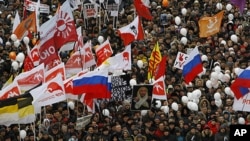
The protesters shouted “New Elections, New Elections,” and organizers say their densely packed mass on Sakharov Avenue reached 100,000 people, which would exceed the numbers who showed up to protest at a similar rally in Moscow two weeks ago.
Russian police estimated this Saturday's turnout at only 30,000.
The crowd Saturday wanted free elections and protested the allegedly tainted victory on December 4 of Prime Minister Vladimir Putin's United Russia party.
A multicolored sea of flags - of liberals and communists, monarchists and anarchists - all waved at one rally for one goal: fair elections in Russia.
Demanding change now
Alexei Navalny, an internet blogger and rising star of the opposition, bellowed through towers of loudspeakers that enough people were gathered to storm Prime Minister Putin’s offices.
He said that Russia’s opposition is peaceful - for now. But he vowed that “next year the leaders will change.”
The United Russia party denies the charges of election fraud raised by Navalny and others.
Saturday’s mass rally indicated, though, how sharply the mood seems to have turned against Putin.
Focus on Putin
In a gathering peppered with homemade signs, one man carried a photograph of Putin wearing a white winter shawl shaped like a condom.
Many protesters were insulted last week when Russia’s Prime Minister joked that he confused their white ribbons of peace with condoms.
Bundled in wool scarves and parkas, the crowd rocked as one rapper ridiculed Putin and corruption in Russia.
Putin has further insulted the protest movement by using old Cold War charges to say that people were demonstrating for money and that they only hit the streets after U.S. Secretary of State Hillary Clinton gave the signal.
Grigory Nikolaevich Zaichenko, a 61-year-old retiree, walked the edges of the crowd holding up a sign that asked, “Where is the money Hillary is handing out?”
He said the combination of blatant fraud and the new ability to communicate through the internet meant that people’s patience has run out.
Kremlin's maneuverings
The Kremlin apparently hoped to cut the protest turnout by issuing a statement Saturday morning saying that the government is hurrying through new laws that will liberalize the registration of parties and presidential candidates.
But hours before the rally, the presidential human rights panel that advises the Kremlin called for the resignation of Russia’s election chief and for new parliamentary elections.
In another reflection of the opposition’s growing strength, Alexei Kudrin, a former finance minister, spoke at the rally. He called for dismissal of the election commissioner and new parliamentary elections.
Looking out at the crowd that stretched for nearly one kilometer, Kudrin said that only dialogue between the opposition and the Kremlin would avoid revolution.
But Leonid Parfyonov, a TV journalist, warned attendees that Russia’s drive for democracy is now or never.
He said if Putin wins a six-year term in the March 4 presidential election, his time in office could equal that of the long-serving Soviet leader Leonid Brezhnev.
Laying out a plan
Mikhail Kasyanov, a former Prime Minister, offered the opposition’s road map for Russia’s political future: Postpone presidential elections to the end of April; hold new, fair and open parliamentary elections next December.
Andrei, a 28-year-old company worker, said he came to the rally to demand the cancellation of the recent parliamentary elections.
“We think that parliamentary election results were a fake actually, so we want the results canceled,” he said.
Reflecting the nationwide nature of the protest movement, demonstrations were also held Saturday in St. Petersburg and dozens of other Russian cities.
By far the biggest was in Moscow, on Sakharov Avenue, a broad boulevard named after the Soviet dissident, Andrei Sakharov.
Ilya, a 31-year-old arts worker, came to the rally with a black-and-white photo of Sakharov pinned to his parka. He said that many of Sakharov’s democracy slogans from the Soviet perestroika period are relevant to Russia today.
In a reminder that Russia, the world’s biggest country, can make large and sudden political changes, this Sunday, Christmas Day, marks 20 years since former Soviet leader Mikhail Gorbachev appeared on national television and dissolved the Soviet Union.