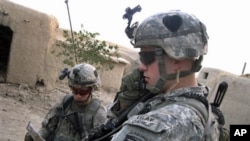
Afghanistan is expected to be high on the agenda at the NATO Summit in Lisbon this week. Media reports say NATO leaders are expected to discuss ending the combat mission in Afghanistan, and handing security over to Afghan forces, within four years.
If approved, the plan would put an end to a lingering controversy, triggered by President Obama's announcement last year that US troops could start coming back from Afghanistan as early as July 2011.
Although Mr. Obama said at the time that any withdrawal would depend on the conditions on the ground, his announcement was widely perceived by many to mean the U. S. might start withdrawing its troops from Afghanistan by July of next year.
Experts even began to speculate that Taliban leaders might change their strategy and just wait for the NATO forces to leave.
U.S. Senator John McCain, the ranking member on the Senate Armed Services Committee, has expressed his concern on that point several times, most recent during a visit to Kabul.
"It sent the wrong message and it created a problem and we need to have the president of the United States state unequivocally that it will be solely conditions-based," McCain said. "And so I worry a great deal about the effect not only here, but it encourages our enemies and it discourages our friends."
Days after McCain's remarks, NATO Secretary General Anders Fogh Rasmussen emphasized the importance of continuing military operations in Afghanistan to force the Taliban to negotiate.
"The fact is that it is the increasing military pressure on the Taliban and its leadership that has stimulated the reconciliation talks," said Rasmussen.
So far, President Obama has been quiet about the controversy his comment has stirred. But his Special Representative for Afghanistan and Pakistan, Richard Holbrooke, stated the current policy in clear terms this week during a visit to Islamabad.
"The policy is to turn over the lead responsibility for security of Afghanistan to the Afghan army and police over the next four years, with the international combat forces phasing out," said Holbrooke.
Those remarks followed Afghan President Hamid Karzai's interview with The Washington Post newpaper during which he demanded a reduction in US-led coalition forces.
Secretary of State Hillary Clinton has also emphasized the deadline is 2014.
"We think that based on conditions on the ground, we support President Karzai's stated goal of transitioning responsibility for all security to an Afghan lead by the end of 2014," Clinton said. "The pace of transition of security responsibility obviously depends on the ability of the Afghan national security forces and Afghan national police forces to be able to take charge."
But Holbrooke went a step further, and made it clear that even after 2014 international forces will remain in Afghanistan to help the government to stabilize the country.
"This is a transition strategy, and not an exit strategy," said Holbrooke. "I say that because I know that the people in this part of the world, in Afghanistan, in Pakistan in the whole region are haunted by the image of 1989 when the Soviet Union withdrew and the US then turned its back on Afghanistan and Pakistan."
Afghanistan experts in Washington say the immediate strategy in Afghanistan should be to send a clear message that international forces are there to stay until the tide is turned against the Taliban -- enough to force them to be a part of a lasting political solution.
Afghanistan High on Lisbon NATO Summit Agenda