



Guinea's injured military leader is in Burkina Faso where he is expected to meet with members of his ruling council, Wednesday. The military chief was shot in December by the former head of the presidential guard.
After more than one month in a Moroccan military hospital, Captain Moussa Dadis Camara arrived in the Burkinabe capital, Ouagadougou, where he was helped from his aircraft by people supporting his arms as he walked slowly to the VIP lounge.
A statement from Burkina Faso's Foreign Ministry says "considering the evolving state of his health," Captain Camara will "continue his convalescence" in Ouagadougou.
Guinea's military leader was shot in the head December 3 by the former head of the presidential guard, because he thought Captain Camara was trying to blame him for the killing of at least 157 opposition demonstrators in September.
A United Nations inquiry into that violence says there are "sufficient grounds for presuming direct criminal responsibility" by the former head of the presidential guard and Captain Camara, as well as other members of the ruling council, for what it calls systematic and organized killing.
Uncertainty about Captain Camara's health has delayed regional efforts to negotiate a power-sharing agreement between the military government and its political opponents.
Acting military leader General Sekouba Konate visited Captain Camara in Morocco, last week, and said that, although his life is not in danger, it will take "time, patience, and additional medical care" before he recovers fully.
General Konate met with American and French officials during that visit. The United States and France both want a civilian-led transitional government to organize free elections and both say that those elections will be more likely if Captain Camara does not return to Guinea. French Foreign Minister Bernard Kouchner says the captain's return could cause civil war.
A coalition of political parties, civil society groups and trade unions is responding cautiously to General Konate's offer for political opponents to choose a new civilian prime minister, as part of that transition process.
Oury Bah, who heads the Union of Democratic Forces party, says there must first be a legal framework for this transition, explaining who is doing what and how they will do it. How long will the transition last? And, what are the new prime minister's powers? Bah says this must all be made clear now to ensure a well-organized transitional authority that has broad support.
Lansana Kouyate heads Guinea's Party for Hope and National Development. He says the opposition alliance must do its best to bring peace to Guinea.
Kouyate says it is important to have a structure in place for the new prime minister. Kouyate asks if he will have the means to exercise real power. He says the objective is not to nominate a prime minister. That is simply part of the process. Kouyate says the real objective is reaching a peaceful end to this transition.
Kouyate says the ultimate objective is organizing credible elections with the broadest possible participation. Wherever the new prime minister comes from, Kouyate says that person must be capable of giving credibility to the election that will follow.
Captain Camara took power in a coup, 13 months ago, promising that no one in his ruling military council would stand for election. But he eventually made clear his intention to run for president, sparking the September protest in which demonstrators were killed and women raped at Conakry's main sports stadium.
The United Nations and the African Union say soldiers should not be allowed to run in Guinea's next election. The military government says it is up to voters to choose who they want to lead the country.
Guinea's Injured Military Leader Moves to Burkina Faso
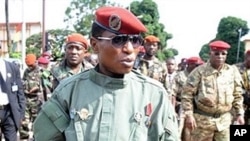
After more than one month in a Moroccan military hospital, Captain Moussa Dadis Camara arrived in the Burkinabe capital, Ouagadougou, where he was helped from his aircraft by people supporting his arms as he walked slowly to the VIP lounge.