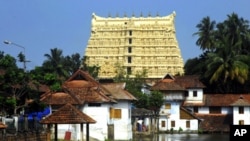



India's Supreme Court is deliberating the fate of a massive treasure trove recently made public at an ancient Hindu temple - riches that the man who brought the case says should be turned over to the local state government. But beneath the glitter of the treasure is a history of royal religious devotion, and a security challenge requiring cultural sensitivity.
These officers carry a sidearm just like any other cop. But they hide it discreetly under the traditional garb of a Hindu pilgrim. A blue shawl clearly identifies them as enforcers of the law.
Night and day, they work with heavily-armed commandos to guard an extraordinary temple in the south Indian city of Thiruvananthapuram, in Kerala state.
The temple's vaults were opened recently in the course of an ongoing legal inquiry into its management. They contain a dazzling treasure of gold, antiquities, and precious stones probably worth tens of billions of dollars.
Most of the world has seen none of it. Although India's Supreme Court has ordered a video inventory of the treasure to take place at some point, for now, religious sensitivities continue to prevent any kind of video or still images from being taken inside the temple.
Police Commissioner Manoj Abraham has been responsible for massively upgrading the temple's security, practically overnight. He is the one who ordered the design of those culturally-sensitive police uniforms.
"We had to have a balance between the religious feelings as such, and the gun-toting police who stay inside," said Abraham.
When the vaults were opened, local leaders were as stunned as the rest of the world to learn of the extent of the temple's wealth.
"Everybody [knew] that there is wealth," said Oommen Chandy. "But not up to this amount."
Oommen Chandy is the chief minister of Kerala. He brushes aside suggestions made by some that the wealth should be used for public purposes.
"It is better to keep the wealth at the temple itself," he said. "This belongs to the temple."
Non-Hindus are not allowed in the temple - a dramatic and intricate structure, decorated with scenes from Hindu scripture.
Inside is a six-meter-long gold statue of the divinity for whom the temple is named: Sree Padmanabhaswamy It's another name for Vishnu, whom Hindus name "the protector." He reclines between Brahma, the creator... and Shiva, the destroyer.
Rain or shine, Swami Durganand Saraswati has come to the temple every day for 25 years to conduct public teachings.
To him and other faithful, there is no question about who owns the wealth.
"It is owned by the deity, Padmanabha Swamy," said Swami Durganand Saraswati.
The historical stewards of the temple are the royal family of Travancore, who once ruled this part of India. And the heir to that lineage, Marthanda Varma, says the wealth should stay right where his ancestors kept it safe.
"Let it continue. What's the hurry? ...There's no harm in letting things be as they are," said Marthanda Varma.
Now 90-years-old, the royal heir would even prefer that the wealth not be exhibited or photographed.
In 1750, the Travancore royal family formally declared itself to be servants of Padmanabha, essentially setting up the deity as the formal ruler, and transferring their wealth to temple.
Some researchers maintain that decision blurred the lines between religion and state. Professor K.N. Panikkar, vice chairman of the Kerala Council for Historical Research, says the public has the right to examine the treasure for clues about the past.
"This is a legacy of the state - and a rich legacy of the state," said Professor Panikkar. "It's not a religious legacy. I mean, I can look upon it as a secular legacy. And in that sense, everyone should be able to see that and appreciate that."
Still Shashi Tharoor, who represents the local area in India's national parliament, says there are big-picture reasons the government should tread lightly when it comes to the temple treasure.
"There are literally hundreds of thousands of temples, churches, mosques in our country," said Tharoor. "If we were to feel that the state had any claim to an asset, or even a percentage of the assets of one temple - what does that precedent mean for every other religious shrine in this country?"
A unique feature of India's legal system is that a deity can actually be regarded as a legal entity. The country's Supreme Court is considering that and more as it determines how the wealth should be managed.
India's Supreme Court Deliberates Fate Of Temple Treasure Worth Billions
- By Kurt Achin