


Not long ago, most professional musicians lived in a world far removed from the nitty-gritty of business management, distribution and promotion. But today, social media, laptop production techniques and fragmented musical tastes have largely replaced the old relationship between musicians, their audiences and the marketplace, making entrepreneurial savvy more important than ever.
A leading U.S. conservatory now teaches students how to create successful careers in this brave new world.
In transition
Robert Sirota, president of New York’s prestigious Manhattan School of Music, takes a small break from his chores to play one of his own compositions. It’s one moment of traditional musical expression in a conservatory that recognizes that the music industry is in major transition.

"Everything we know about the business of music-making, and the industry of music - including recordings, the dissemination of published materials, concert venues, the way people get compensated for performance and concerts - have changed radically in the last 20 years," he says, "and it became clear to me and other people of like mind to figure out how to develop young artistic leaders who are truly capable of making their way in this brave new world."
That’s why the Manhattan School of Music created the Center for Music Entrepreneurship, where students can learn about new media, fundraising, launching their own concert series, producing their own recordings, creating a press kit and other necessary skills.
Business sense
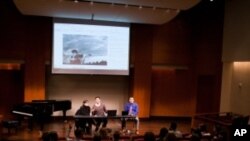
In a nearby lecture hall, students like pop composer Yuma Sung are learning about intellectual property rights law as part of the center’s "Setting the Stage" program.
"If someone tries to steal some of my stuff, and if I chose to go to court, I’d know how to deal with it properly," says Sung.
Sirota, who completed his own conservatory education in the 1970s, contrasts today’s hyper-wired world with what used to be.
"The status quo as we understood in the music world, was that there were a small number of major international symphony orchestras, there was a select coterie of very elite performers, and there was an established audience of concertgoers," he says. "There were in addition, several multi-national record companies. But what has happened is the way people listen to music has changed."
Indeed, most people now listen to music through digital music players, or through downloads, and CDs are mostly a thing of the past, which is why Sirota believes the old business model no longer makes sense.
Responsible advocates for art
Edward Klorman, who directs the center, says the 21st century musician is a multi-tasking entrepreneur. "Sometimes you’re performing. Sometimes you’re an administrator. Sometimes you’re the one marketing your own concert. If we’re passionate about the music we play, we need to be responsible advocates for our art."

Mari Hwang studies piano, harpsichord and conducting at the conservatory. She's learning marketing skills, which connect her to audiences in ways that have little to do with musical talent. "In a conservatory setting we always focus on performance, but a lot of times we [stay] in a practice room and we don’t really learn how to speak to your audience or how to interact with it or how to create new programs for people. And here we learn how, and it’s going to be very beneficial for my career."
Klorman knows that many young musicians are daunted by the expertise needed to sustain a successful career today. However, he says the current climate rewards personal initiative and imagination as never before. "And if we are creative about putting together new opportunities, we can carve out a whole new market for ourselves."
Non-traditional approach
He encourages classical musicians can play in nightclubs and other non-traditional venues.
Klorman himself initiated the highly successful "Classical Blue Jeans" series in upstate New York, where both audience members and musicians wear blue jeans, share a pre-concert barbecue and repair to a barn for the concert itself, where concertgoers are invited to offer instant feedback to the musicians.
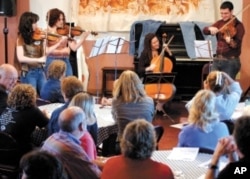
Klorman says it’s all done in a spirit of inclusion and fun. "It makes for a much more dynamic music world for all of us, and it’s a much more exciting way to live your life as a musician."
The courses at the Center for Music Entrepreneurship are among the most popular at the Manhattan School of Music. In fact, demand has begun to exceed slots, and the program is expanding. This success has in turn inspired other conservatories to teach business skills for tomorrow’s musical careers.