


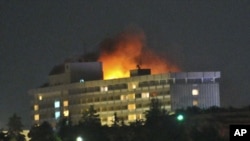
The Taliban assault on the Intercontinental Hotel in Kabul, which left 11 civilians and police dead in addition to the attackers, comes as NATO forces are beginning a process of handing over security to local authorities. Afghan officials say despite the attack, that handover will continue.
Afghan President Hamid Karzai says the attack in the nation’s capital will not deter Afghanistan's forces from taking over their security role as planned.
The Taliban claimed responsibility for the highly coordinated attack on the landmark Intercontinental Hotel in an apparent attempt to show they are still able to carry out such assaults - despite months of heavy attacks by NATO and Afghan forces.
Related Video: Afghan Violence
Afghan National Security Directorate spokesman Luftullah Mashal says the insurgents may have taken advantage of a gap in security caused by renovations to the hotel.
The Intercontinental, built on a hill overlooking Kabul in the 1960s, was once the premier hotel in the Afghan capital - hosting conferences and many foreigners. Visitors must cross through several checkpoints along a winding road to reach the hotel.
"There was a loophole in the security, definitely. Investigation will definitely take place. There was reconstruction and renovation work also going on in a part of the hotel," said Marshal. "The insurgents are using every means to infiltrate into tight security areas."
Initial reports indicate that a small group of heavily armed men stormed into the hotel late Tuesday with automatic weapons, grenade launchers and suicide belts. The ensuing gun battle lasted more than five hours.
Afghan police initially cordoned off the area. An Afghan special commando unit arrived later, and NATO helicopters provided assistance.
According to NATO spokesman Master Sergeant Jason Haag, coalition forces mobilized at the request of the Afghan Ministry of the Interior, but the response was conducted primarily by the Afghan security forces.
"We were called in, specifically for air asset. We also had some ISAF-embedded mentors that were part of the Afghan unit that was involved in the response," said Haag. "We did put some assets on standby as well, just in case. Medevac and some explosives folks were on standby but they did not actually respond.
Haag went on to say that this was mostly "an Afghan-led operation and we just provided those couple of supporting roles."
The spokesman added that the NATO helicopters did fire at insurgents who had taken positions on the hotel’s roof.
The fighting ended early Wednesday with all the insurgents killed.
Key installations in Kabul and around the country remain on high alert as a result of the assault on the hotel.
The last major attack on a Kabul hotel was in 2008, when militants stormed the luxury Serena Hotel in the center of the city, killing eight people in a coordinated assault.
A summit on the security transition was supposed to take place at the Intercontinental on Wednesday, and many Afghan provincial officials who are taking part were staying at the hotel.
The transition commission was set to discuss Afghan preparations for the international troop withdrawal.
Security control of seven areas in Afghanistan are set to be handed over to Afghan forces next month, with all foreign combat troops expected to leave Afghanistan by the end of 2014.