



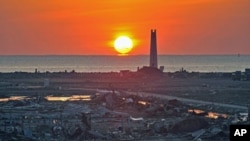
The United Nations reports 2011 was the costliest year in history for catastrophes. It says economic losses from natural disasters, including earthquakes, storms and floods, amounted to $366 billion.
The United Nations reports about 206 million people were affected by just more than 300 natural disasters in 2011. Of these, 30,000 people died.
The United Nations says the number of natural disasters last year was lower than average for the past 10 years, though, and the number of deaths also is far lower than that recorded for 2010.
The director of the Centre for Research on the Epidemiology of Disasters at the University of Louvain, Belgium, Debarati Guha-Sapir, said the 2011 death toll is less because 2010 had several spectacular earthquakes.
“You are likely to get more deaths from earthquakes if it is a poor country than if it is a rich country. In this particular case, out of the 29,782 dead [in 2011] about two-thirds of it, about 20,000 of this comes directly from the tsunami and the earthquake in Japan,” said Guha-Sapir.
By comparison, the earthquake, which struck Haiti in January 2010, killed nearly 250,000 people.
Haiti’s economy suffered $8.5 billion in damages. But the Japan earthquake and tsunami in March caused economic losses of $210 billion, making it the costliest natural catastrophe of all time.
Japan, Thailand, New Zealand, the United States and China figure among the top 10 disasters in terms of economic losses in 2011. The countries that had the most deaths include Japan, the Philippines, Brazil and Thailand.
The report notes the overwhelming number of deaths and economic damages were in Asia. Guha-Sapir said storms and floods account for nearly 70 percent of the world’s natural disasters. As such, she said, they have the greatest impact on humans.
“One is by simply killing them," he said. "There is a lot of drowning, a lot of blunt trauma that happens and does not get picked up. There is an increase in diseases, an important increase in diseases by floods. And thirdly and most importantly is in malnutrition and hunger because agriculture losses are very high in these countries. Harvests are lost. Farmers and subsistence farmers and the children go hungry after a flood. Therefore you get pervasive malnutrition in areas where there have been floods."
Drought and famine end up causing a huge number of deaths, but Guha-Sapir said these deaths go uncounted, and a disaster such as that occurring in the Horn of Africa does not get counted in the statistics. She explained this is because people do not die of famine, they die from related causes, such as measles or organ failure and infections brought on by malnutrition.