


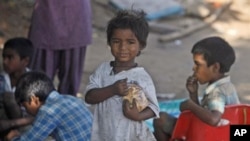
The United Nations says the number of hungry people in the world has gone down by almost 1 million in the last year but the figure still stands at 925 million.
2010 is a significant date in the world's fight against global hunger: it marks 30 years since the first World Food Day and 65 years since the founding of the United Nation's Food and Agriculture Organization.
Progress made
Caroline Hurford is from the U.N.'s World Food Program. She says in the 30 years since the first World Food Day, real progress has been made. According to the Global Hunger Index 2010, the proportion of hungry people in the world has gone down by one quarter since 1990.
But Hurford says some stumbling blocks have been hit in recent years. "There has been a slight dropping off in the number of hungry people in the late 1990s but then it rose again of course during the financial crisis of 2007-2008," she said.
"And then the very high food prices together with the high fuel prices really knocked everything off track again and we're just finding that more and more people are unable to afford to buy food and then of course climate change has come in and that's made it more difficult to grow food," Hereford added.
Fighting hunger is the first of eight Millennium Development Goals that world nations set ten years ago. Now the 2015 deadline is fast approaching and many people say they fear the target will not be met.
Some countries and regions are making progress. South Asia has made the largest improvements and many sub-Saharan African countries have also made advances, including Ghana, Ethiopia, and Angola.
But improvements are not consistent globally. The largest deterioration has been in the Democratic Republic of Congo, which has been wracked by conflict and political instability.
Hurford says environmental catastrophes, like drought, and conflict are two major barriers to fighting hunger. "Clearly conflict is a huge problem as far as the actual growing of produce and crops is concerned," she said. "People cannot necessarily tend their fields if they are always being chased away by armed rebels and they're too frightened to stay at home and look after animals. So really that's one of the biggest problems."
In conflict-ridden countries like the DRC, emergency aid levels are high - in Somalia, for example, it accounts for 64 percent of the assistance the country receives.
Future steps needed
Edgardo Valenzuela is from the United Nation's Food and Agriculture Organization. He says if hunger is to be reduced, a new tactic is necessary.
He says emergency aid for countries is important but investment in agriculture needs to be a top priority.
"This kind of short term relief is not enough because for these countries which are in perpetual crisis, or in protracted crisis, there is a need to be able to develop a system to help them to able to plant and grow their food, because otherwise they will never have a sustainable way to eradicate hunger," said Valenzuela.
Aileen Kwa is an analyst with the South Center, a developing countries think tank based in Switzerland. She says the traditional two-pronged approach to fighting hunger, emergency aid and sustainable development, are not enough. She says an economic overhaul is needed.
She says many African countries suffer because they have eliminated subsidies and reduced tariffs. She says these economic policies were recommended by the World Bank and the International Monetary Fund and are not working.
"By eliminating or reducing their tariffs on agricultural products, it meant that a lot of agricultural produce from Europe, for instance, and from the U.S. too, was flooding into these countries and basically squeezing out the small holders," said Kwa. "Many of the developed countries have continued their subsidies so they're products are actually artificially cheap and they out compete the domestic farmers in Africa and even in parts of Asia."
In order to end the world food crisis, she says, governments have to have the political will to make international trade more fair.
According to the United Nations, two-thirds of the world's undernourished live in just seven countries: Bangladesh, China, India, Indonesia, Pakistan, the Democratic Republic of Congo and Ethiopia.
The proportion of undernourished people is highest in sub-Saharan Africa - 30 percent of the continent's population.