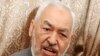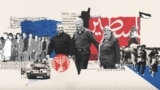




Last week, Sheikh Rachid Ghannouchi and other members of the Islamic al-Nahda Party returned to Tunisia after more than two decades in exile. Ghannouchi’s return—and the warm welcome he received at the Tunis airport—touched off concerns about a resurgence of political Islam in the North African country.
No one is more concerned than Tunisia's women, who have enjoyed more than half a century of political, legal and personal freedoms unprecedented in the Arab world. The 1956 Personal Status Code gave women a key role in Tunisian society; it abolished polygamy, allowed women the right to divorce and gave them access to birth control and abortion.
Today, 99% of Tunisian women are educated. Women participate actively in politics, law, medicine, academia, media and business.
Mariam Saari, a Tunisian women’s rights activist, told VOA she was surprised by how many women supporters turned up to welcome Ghannouchi.
“Tunisian women, we have freedom, we get paid the same as men. We can vote. We can divorce. We can make our own businesses, for years now,” Saari said.
She wonders how women, in light of their hard-won gains in Tunisia, could support a religious figure who has publically declared his commitment to Sharia—or Islamic law—under which women have fewer rights and liberties than men.
In the biography, Rachid Ghannouchi: Democrat within Islam, Azzam Tamimi describes Ghannouchi as supporting a balance of democracy and what he calls the “moral authority” of Islam. Critical of the Personal Status Code and anti-polygamy laws at first, Tamimi writes that by the 1980s, Ghannouchi had decided the code was “acceptable” to his al-Nahda movement.
“What Rachid Ghannouchi advocates,” Tamimi told VOA, “is a democratic system that gives the people the ultimate choice of freedom. They choose their government, government is accountable to the people, and he doesn't see any incompatibility between the democratic procedure and Islamic values.
"And I have him on the record saying that if the Tunisian people were to choose Communism as a system of governments or liberalism as a system of government, we have no choice but to accept that and respect it and try to change it through democratic means in the following election.”
In a televised interview with France24 television a few days prior to his return to Tunisia, Sheikh Ghannouchi insisted he did not intend to run for president or hold any ministerial post in a new Tunisian government. However, this has not completely allayed fears among secular Tunisians that the collapse of the Ben Ali government—and Ghannouchi’s return—will open the door to a political legitimacy which al-Nahda was long denied. They are also concerned that a revival of Islam in Tunisia could lead to the infiltration of religious extremists from neighboring Algeria.
Tunisia has been strongly secular ever since it won independence from France in 1956. Both Presidents Habib Bourguiba and Zine al Abeddin Ben Ali suppressed the Islamic veil on women or beards on men. Tunisia’s legal system is based both on French civil and Islamic codes. Sharia courts were abolished in 1956, but the constitution declares Islam the state religion and stipulates that the President of the Republic must be a Muslim. Ghannouchi has, in the past, gone on record as saying that the Quran and Sunna are the “ultimate law.”
So, could Tunisia possibly see a return of religious law?
“It is up to the people to decide if the majority of the people in Tunisia or in Egypt opt to remove such incompatibilities,” said Tamimi. “That's a choice that has to be respected, and I'm sure that al-Nahda movement would want to see a system of law and a system of governance that is in full compatibility with Islam.”
Tunisian-born Larbi Sadiki is Senior Lecturer in Middle East Politics at the University of Exeter in Britain and author of Rethinking Arab Democratisation: Elections without Democracy. He was on the airplane that brought Ghannouchi back to Tunisia. “He arrived to a quite joyous reception,” he said. “Huge crowds, maybe five, six thousand people, which is amazing. If anything, it's an affirmation or confirmation of the following still enjoyed by the al-Nahda Party after more than 20 years in a political wilderness.”
However, Sadiki said he does not believe a resurgence of fundamentalism will occur in Tunisia. He characterizes Ghannouchi as a proponent of what he calls as “soft Islamism,” more along the lines of the Justice and Development Party—or AKP—in Turkey, and far removed from the Taliban or even the Muslim Brotherhood in Egypt. Sadiki said Ghannouchi has “adjusted his ideas very, very deeply, in a way that makes him approving of democracy or democratic transition, the place of woman, for instance, the Personal Status Code, which is something the Islamists contested in the 1970s and 80s." Sadiki said that Ghannouchi's change of mind about the Code "allayed the fears" of women and other secular forces in the country.
Sadiki said believes that the al-Nahda party returns to Tunisia not to dominate politically, but to share power with other groups. “Ghanouchi himself,” he said, “when I was talking with him [on the airplane] and also, this is from his own pronouncements to the media and to the world, says that he will focus on bottom-up civic society building--government institutions and associations. I do not really expect Ghannouchi, at the moment, to be talking about trying to confront Tunisia's society, which is still confused, with such debates.”
Sadiki paused for just a moment and then added, “It’s just not the time for that. He won't do that.”
Though elections will not take place in Tunisia for several months, women’s groups in Tunisia will likely remain vigilant. Miriam Saari said she is not terribly worried. The fight for women’s rights is part of the fight for democracy, she said. “Tunisian women love their freedom too much to give it up.”