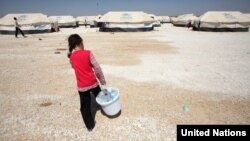
A Syrian girl carries a bucket filled with bottles of precious water to her family's tent in Jordan's al Za'atri refugee camp, September 04, 2012. (UNHCR)
Among its neighbors, the Hashemite Kingdom has received the largest number of refugees fleeing Syria's conflict and is paying a high price for it
As Syrians flee from a deadly civil war between rebel forces and President Bashar al-Assad’s military, neighboring countries are struggling to take care of more than 450,000 refugees.
And the number of Syrian refugees, compiled by the UN High Commissioner for Refugees, is expected to double within a few months, compounding an already dire situation.
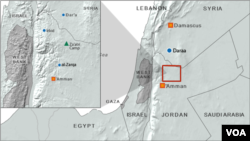
Turkey, which has closed some of its border crossings, has taken in about 100,000 Syrian refugees. Lebanon has registered about 94,000. Iraq has received about 39,000. But the largest share of refugees are in neighboring Jordan, whose frontier is only a few kilometers south Daraa, the birthplace of Syria’s 18-month-old effort to depose the Assad regime. Refugee officials in Jordan estimate they are serving more than 200,000 refugees, noting that 105,000 have registered, but that many more have refused to register.
As the civil war continues, refugee camps established beyond Syria’s borders are growing quickly, but the funds needed to support them are not -- despite the world-wide attention focused on the situation when Tony Lake, executive director of the U.N. children’s agency (UNICEF), visited to the settlements with film star Angelina Jolie, a special envoy for U.N. High Commissioner for Refugees (UNHCR).
The most important thing is that we’re on the verge of winter and most of the occupants of that camp are living in tents.
Anmar al-Hmoud, Higher Committee for Syrian Refugees in Jordan
The consequence is that suffering in these camps is increasing and the burden on the host countries deepens.
Jordan is a poor desert nation with a government deeply in debt and a history of serving as a refuge for large neighboring populations displaced by political disasters. It also has a severe shortage of natural resources, including water.
Though Jordan now hosts an estimated 200,000 Syrians, officials say it needs to prepare urgently for twice that many. The officials point out, however, that the situation could even be more serious because some Syrians refuse to register when they arrive in Jordan, fearing the Assad regime may learn their identities.
While the majority of Syrians in Jordan are living with friends, relatives or in rental housing, an estimated 36,000 live in the Za’atri refugee camp. The largest percentage are women, children and the elderly who live in a windswept sea of tents emblazoned with the letters “UNHCR.” The tents were set up three months ago in the desert about an hour’s drive from the Syrian frontier.
Winter temperatures are dropping in Za’atri
“The main challenge at Za’atri is the dust and the heat,” said Ayman al-Mufleh, the secretary-general of the Jordan Hashemite Charity Organization, which manages the camp. “That’s why we’re trying to change from tents to houses.”
The Jordan Hashemite Charity Organization, or JHCO, is a government agency that also provides food, medical assistance, housing stipends and other services for Syria’s larger popular of urban refugees as well.
The charity group says it needs $60 million to buy and erect 12,000 prefabricated dwellings that can house about 60,000 people in coming months.
Living conditions in Za’atri already are becoming critical. In recent weeks, small groups of refugees have protested camp conditions. When a sandstorm blew over several of the tents, a gang of protesters set fire to a hospital. In one incident, threatened UNHCR staff had to withdraw from the camp for several hours.
Several Arab countries have donated funds for construction of pre-fabricated structures being made in Amman, but agency officials expect to have less than half of Za’atri refugees in prefab housing this winter when temperatures drop to 1.6 degrees centigrade.
We have to be prepared for more people to come across, particularly as winter starts hitting in Syria and the situation could become more desperate.
Andrew Harper, UNHCR
“The most important thing is that we’re on the verge of winter and most of the occupants of that camp are living in tents,” Anmar al-Hmoud, an official from the host country’s Higher Committee for Syrian Refugees in Jordan, said in Amman last week.
The Za’atri camp is supported by about 200 staff of the UNHCR and others from more than 80 other U.N. agencies and non-government organizations such as the International Committee of the Red Cross, Mercy Corps, Handicap international, Oxfam, Jesuit Refugee Service, Muslim Aid, Save the Children, and the German Federal Agency for Technical Relief.
Serving more than 200,000 refugees from Syria
Time and money are crucial to refugee survival in Jordan’s harsh desert climate this winter, said Andrew Harper, Jordan representative of the UNHCR. UNHCR and JHCO have made a joint appeal for international donations of $250 million to meet anticipated needs at Za’atri as well as an estimated 170,000 of Syria’s “urban refugees” in Amman and elsewhere in the country. But so far, pledges have been slow to roll in.
“We have to be prepared for more people to come across, particularly as winter starts hitting in Syria and the situation could become more desperate,” Harper said.
“The situation is deteriorating greatly in the southern part of Syria, which is Daraa and the villages around it,” said Hmoud. “Our people hear the bombardment clearly and we expect the more suffering, the influx will be much more.”
Za’atri can accommodate about 60,000 refugees. Refugee officials are investigating another site in al-Zarqa closer to Amman, and a possible third site if the need arises. Refugee officials also are also looking for a separate site to segregate many of the single males suspected of involvement in some of the violent incidents.
Threats to Jordan’s fragile aquifer and unstable economy
The difficulties in Za’atri are a condensed version of what is happening in many parts of Jordan, which ranks as one of three countries in the world with the most critical water shortages.
First it was the Palestinians, the Iraqis, in 1990, then the Lebanese and again the Iraqis, then the Syrians.
Ayman al-Mufleh, Jordan Hashemite Charity Organization
The camp is located on the edge of a 300-meter deep aquifer that provides fresh water for most of Jordan. But until wells are completed, water is being trucked in daily in what officials say is a costly operation.
“It (water) is really a major issue,“ said Hmoud, who complained that Syrians in the camp waste lots of potable water. “Where they come from, Syrians have ample water. They don’t think of, they do not consider conserving water. When they use it they use it liberally, unlike Jordanians.”
Another necessity missing at Za’atri is jobs. With 14 percent unemployment, Jordan offers few work opportunities for its own jobless, much less refugees. For the few jobs that are available, the JHCO hopes that most go to Jordanians.
But such desperate situations are not new to Jordan, a nation that has been host for many refugees during decades of Middle East turmoil.
“First it was the Palestinians, the Iraqis, in 1990, then the Lebanese and again the Iraqis, then the Syrians,” said JHCO’s Mufleh. The government claims there are 500,000 Iraqis still in Jordan. ”We are surrounded by Iraqis, Palestinians, Lebanese and Syrians. We have created a safe haven for them.
“We like to help others, but … because of the issues of economics and employment, it is hard for us to receive refugees without affecting normal life for Jordanians.”
The Hashemite Kingdom of King Abdullah II can do little for these refuges without donor help, said Harper, because “the government is running a deficit of $3 billion a year and doesn’t have very much natural resources of its own.
“But it has done the right thing by the international community by keeping its borders open.”