


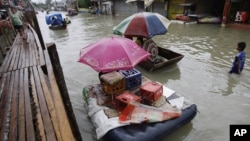
BANGKOK— Recent flooding disasters in Asian capitals are a warning of worse problems to come for city planners. The Asian Development Bank says rapid urbanization is straining city infrastructure, leading to worse pollution, and putting millions in Asia at risk.
Heavy monsoon rains this month left a third of the Philippine capital, Manila, under water.
In July, the Chinese capital, Beijing, saw the worst flooding in 60 years.
And last year, the Thai capital, Bangkok, was partly swamped by historic floods that killed over 800 people.
Asian Development Bank chief economist Changyong Rhee says although weather-related tragedies are common in Asia, it is not because of bad luck.
“This kind of natural disaster, especially flooding in Asia, is a result of the combination of growing risk of global warming and climate changes together with rapid and massive urbanization in Asia without proper infrastructure,” says Rhee.
Rhee was speaking to the Foreign Correspondents Club of Thailand for the release of an ADB study titled Green Urbanization in Asia.
The ADB says carbon emissions, believed to be a major cause of climate change, grew five times as fast in Asian cities as the world average and are set to triple by 2050.
Asia’s booming economic growth, while lifting many out of poverty, is leading millions to move to cities for better jobs.
The ADB says Asia is now home to more than half the world’s megacities, those with populations over 10 million, and 60% of global slum dwellers.
In 1950, there were only two megacities in the world, New York and Tokyo, but now there are 23, 12 of them in Asia.
Rhee says city planners are struggling to keep up with needed infrastructure, creating a growing and vulnerable slum population.
“The bad news is that this vulnerability is more likely to increase with urbanization. Why? Because with urbanization there will be more people living in urban slums," says Rhee. "They live in a risk area. And, without proper infrastructure, they are subject to this risk.”
The ADB says the Asian population vulnerable to inland flooding is expected to reach 350 million by 2025.
Those vulnerable to coastal flooding will increase to 400 million.
To meet the challenge, the ADB says cities need to focus on alleviating poverty, promoting environmentally friendly planning and technology, and boosting energy efficiency.
Rhee says the most important step is building efficient mass transit systems to reduce dependence on pollution-heavy fossil fuels.
He says the emergence of satellite cities near Asian megacities creates the opportunity to incorporate “green” concepts early on.
Heavy monsoon rains this month left a third of the Philippine capital, Manila, under water.
In July, the Chinese capital, Beijing, saw the worst flooding in 60 years.
And last year, the Thai capital, Bangkok, was partly swamped by historic floods that killed over 800 people.
Asian Development Bank chief economist Changyong Rhee says although weather-related tragedies are common in Asia, it is not because of bad luck.
“This kind of natural disaster, especially flooding in Asia, is a result of the combination of growing risk of global warming and climate changes together with rapid and massive urbanization in Asia without proper infrastructure,” says Rhee.
Rhee was speaking to the Foreign Correspondents Club of Thailand for the release of an ADB study titled Green Urbanization in Asia.
The ADB says carbon emissions, believed to be a major cause of climate change, grew five times as fast in Asian cities as the world average and are set to triple by 2050.
Asia’s booming economic growth, while lifting many out of poverty, is leading millions to move to cities for better jobs.
The ADB says Asia is now home to more than half the world’s megacities, those with populations over 10 million, and 60% of global slum dwellers.
In 1950, there were only two megacities in the world, New York and Tokyo, but now there are 23, 12 of them in Asia.
Rhee says city planners are struggling to keep up with needed infrastructure, creating a growing and vulnerable slum population.
“The bad news is that this vulnerability is more likely to increase with urbanization. Why? Because with urbanization there will be more people living in urban slums," says Rhee. "They live in a risk area. And, without proper infrastructure, they are subject to this risk.”
The ADB says the Asian population vulnerable to inland flooding is expected to reach 350 million by 2025.
Those vulnerable to coastal flooding will increase to 400 million.
To meet the challenge, the ADB says cities need to focus on alleviating poverty, promoting environmentally friendly planning and technology, and boosting energy efficiency.
Rhee says the most important step is building efficient mass transit systems to reduce dependence on pollution-heavy fossil fuels.
He says the emergence of satellite cities near Asian megacities creates the opportunity to incorporate “green” concepts early on.