


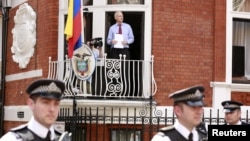
LONDON — Foreign ministers from Latin America meet in Washington Friday to discuss Julian Assange, the founder of Wikileaks who has been living inside Ecuador’s London Embassy for over two months. Ecuador has granted Assange asylum but Britain has made it clear that the founder of Wikileaks will be arrested if he leaves the Ecuadorian embassy.
Last week Britain made a written warning to Ecuador, saying it could invoke a 1987 act to arrest Assange inside the embassy. Ecuador said it saw that letter as a “threat,” which Britain has denied.
But the situation has created diplomatic tension between Britain and Ecuador and infuriated Assange supporters.
Across the street from the Ecuadorian embassy in London, protesters are holding what they call a “vigil” - they say it is a 24-hour watch in order to ensure that Assange is not forcibly removed from the embassy by British police.
One protester, who declined to give his name, spoke to VOA. “It’s a cause of deep concern that people have to seek extradition from the United Kingdom and it’s very much Mr. Assange’s right to do so and it’s the Ecuadorians’ authority to be able to grant that,” he said.
Assange entered Ecuador’s embassy in London more than two months ago requesting asylum. His aim was to avoid being extradited to Sweden, where he is wanted for questioning about rape and molestation claims, which he denies.
He says he believes his extradition to Sweden would lead to further extradition to the United States to face charges related to Wikileaks, an organization that has released hundreds of thousands of classified U.S. cables.
Anand Doobay is an extradition lawyer at Peters & Peters Solicitors in London. He described the circumstances under which British police might enter a foreign embassy.
“The UK Legislation says well look if you use the embassy for an unpermitted reason - and to take an extreme example, let’s say that there is somebody in the embassy who has a gun and is just shooting people from the embassy, obviously that is not a permitted reason so the act then allows the UK to say, we are ceasing to recognize you as an embassy because you are doing something that is not allowed under international law and we are going to enter the embassy,” said the lawyer.
He says it would be an “extreme thing to do.” He says Britain would only be able to do it if it believed it was making a decision in accordance with international law.
“I think that it is very unlikely that the UK Would choose to go down that route because it is very aware that its own embassies need to be secure around the world and it wouldn’t want other countries, or rather people or protesters, to feel that they could invade its embassies without any redress,” said Doobay.
Officials in Ecuador have said Assange can stay in the embassy for as long as he wants. Even, they say, for “two centuries” if necessary.
Last week Britain made a written warning to Ecuador, saying it could invoke a 1987 act to arrest Assange inside the embassy. Ecuador said it saw that letter as a “threat,” which Britain has denied.
But the situation has created diplomatic tension between Britain and Ecuador and infuriated Assange supporters.
Across the street from the Ecuadorian embassy in London, protesters are holding what they call a “vigil” - they say it is a 24-hour watch in order to ensure that Assange is not forcibly removed from the embassy by British police.
One protester, who declined to give his name, spoke to VOA. “It’s a cause of deep concern that people have to seek extradition from the United Kingdom and it’s very much Mr. Assange’s right to do so and it’s the Ecuadorians’ authority to be able to grant that,” he said.
Assange entered Ecuador’s embassy in London more than two months ago requesting asylum. His aim was to avoid being extradited to Sweden, where he is wanted for questioning about rape and molestation claims, which he denies.
He says he believes his extradition to Sweden would lead to further extradition to the United States to face charges related to Wikileaks, an organization that has released hundreds of thousands of classified U.S. cables.
Anand Doobay is an extradition lawyer at Peters & Peters Solicitors in London. He described the circumstances under which British police might enter a foreign embassy.
“The UK Legislation says well look if you use the embassy for an unpermitted reason - and to take an extreme example, let’s say that there is somebody in the embassy who has a gun and is just shooting people from the embassy, obviously that is not a permitted reason so the act then allows the UK to say, we are ceasing to recognize you as an embassy because you are doing something that is not allowed under international law and we are going to enter the embassy,” said the lawyer.
He says it would be an “extreme thing to do.” He says Britain would only be able to do it if it believed it was making a decision in accordance with international law.
“I think that it is very unlikely that the UK Would choose to go down that route because it is very aware that its own embassies need to be secure around the world and it wouldn’t want other countries, or rather people or protesters, to feel that they could invade its embassies without any redress,” said Doobay.
Officials in Ecuador have said Assange can stay in the embassy for as long as he wants. Even, they say, for “two centuries” if necessary.