PEPFAR, the President’s Emergency Plan for AIDS Relief, is credited with saving millions of lives in developing countries. The program, which started under President Bush, continues under President Obama. However, despite the success, supporters say PEPFAR faces many challenges due to a poor economy and partisan politics.
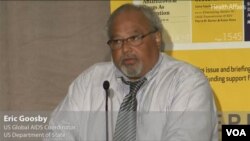
U.S. Global AIDS Coordinator Eric Goosby, the man in charge of PEPFAR, said many people are responsible for the program’s success.
“The healthcare providers, faith-based organizations and community groups, the businesses, the people living with HIV – they are the hands and feet who have led the transformation over the past decade. It’s thanks to them that the PEPFAR program was able to make incredible progress in both a programmatic impact, but just as importantly, in returning and expanding hope to the communities in which we work,” he said.
Dr. Goosby said PEPFAR has taught the world much about tackling a global epidemic. He says less than a decade ago the “hopelessness was overwhelming.”
“Despite the complexities of AIDS as a disease to diagnose and to treat, the United States took it on with a targeted approach on a large-scale and with accountability for results. Yet what even many experts don’t appreciate is the broader transformational impact of this work on the health sector,” he said.
He said improving hospitals, clinics and labs, as well as training healthcare workers and creating better supply chains have also strengthened health care systems in developing countries.
“That helps us understand the improvements we’ve seen in non-HIV indicators such as maternal, child and TB related mortality, use of ante-natal care and safe blood supply. I believe we just scratched the surface of what can be achieved on these platforms,” he said.
Ambassador Goosby said PEPFAR will continue to push for “country ownership” of HIV/AIDS programs. This gives local health officials greater authority in tailoring programs to their needs. It does not mean an end to PEPFAR funding at this time.
“These frameworks have also given us a forum in which to highlight policy or other issues that may be holding countries back, whether it’s failure to focus on key populations at highest risk, lack of inclusion of women, or not collaborating with the faith sector that does so much of the work. Of course another recurring barrier is an adequate investment in health from national budgets,” he said.
He added that “shared responsibility” is what will allow PEPFAR programs to expand.
PEPFAR works closely with the Global Fund to Fight AIDS, Tuberculosis and Malaria, and Goosby praises the fund’s efforts and reforms.
He said that an AIDS-free generation is not only possible, it’s something that must be achieved.
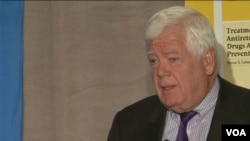
One of the major supporters of PEPFAR is Democratic Congressman Jim McDermott – a medical doctor and co-chair of the Congressional HIV/AIDS Caucus. He is a former regional medical officer for the State Department in the then-Zaire.
Rep. Jim McDermott (D-WA) (Health Affairs)
“I arrived there in ’87 right in the middle of the beginning of the epidemic when Mama Yemo Hospital in Kinshasa had hundreds of people lying on the floor just dying,” he said.
He said in the early days of the epidemic, few members of congress were interested. He disagreed with former President Bush on many political issues, but says Mr. Bush “got it right” when he launched PEPFAR in 2003.
McDermott warns that today’s intensely partisan politics – coupled with a poor economy - have resulted in only short-term support for PEPFAR – funds just for fiscal year 2013.
“It isn’t very reassuring. I get calls from my friends in South Africa and other countries saying, what’s going to happen? Are we going to have a program next year? Where’s it going to go? So the anxiety is flowing out all over the world as the Congress dawdles here on the Hill,” he said.
He warned PEPFAR is not immune from budget sequestration -- automatic, across-the-board cuts that take effect if the president and congress fail to agree on deficit reduction. McDermott said such cuts could result in a lot more AIDS-related deaths and many more orphans.
Over the years, PEPFAR has spent tens of billions of dollars to fight HIV/AIDS.