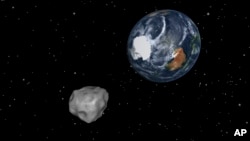
NASA says an asteroid will fly extremely close to Earth next week, but no one has to head for the hills or take shelter in a cave. It is the closest ever predicted Earth approach for an object this large.
The asteroid, known as 2012 DA14, will fly about 27,520 kilometers above the Indian Ocean next Friday - so close that it will pass inside the ring of geosynchronous weather and communications satellites.
NASA scientists say there is no chance the space rock measuring about 45 meters across will hit our planet.
The speeding asteroid will be too small to be seen with the naked eye as it passes overhead. Through a telescope it will appear about the size of a distant star as it moves rapidly across the sky at 28,100 kilometers per hour, about eight times as fast a rifle bullet.
NASA says this is the one of the largest asteroids ever to come this close to Earth, but other, much larger space rocks have crashed into Earth's surface millions of years ago, causing calamitous damage.
The last asteroid to cause serious destruction on the ground exploded over the Siberian forest in 1908. If another asteroid of a similar size were to impact Earth, it would release approximately 2.5 megatons of energy in the atmosphere causing "regional devastation," said NASA.
Scientists believe there are approximately 500,000 near-Earth asteroids the size of 2012 DA14. Of those, less than one percent have been discovered.
Asteroid 2012 DA14 was discovered by the La Sagra Sky Survey operated by the Astronomical Observatory of Mallorca in Spain on February 23, 2012. The asteroid was about 4.3 million kilometers away when it was detected.
The asteroid, known as 2012 DA14, will fly about 27,520 kilometers above the Indian Ocean next Friday - so close that it will pass inside the ring of geosynchronous weather and communications satellites.
NASA scientists say there is no chance the space rock measuring about 45 meters across will hit our planet.
The speeding asteroid will be too small to be seen with the naked eye as it passes overhead. Through a telescope it will appear about the size of a distant star as it moves rapidly across the sky at 28,100 kilometers per hour, about eight times as fast a rifle bullet.
NASA says this is the one of the largest asteroids ever to come this close to Earth, but other, much larger space rocks have crashed into Earth's surface millions of years ago, causing calamitous damage.
The last asteroid to cause serious destruction on the ground exploded over the Siberian forest in 1908. If another asteroid of a similar size were to impact Earth, it would release approximately 2.5 megatons of energy in the atmosphere causing "regional devastation," said NASA.
Scientists believe there are approximately 500,000 near-Earth asteroids the size of 2012 DA14. Of those, less than one percent have been discovered.
Asteroid 2012 DA14 was discovered by the La Sagra Sky Survey operated by the Astronomical Observatory of Mallorca in Spain on February 23, 2012. The asteroid was about 4.3 million kilometers away when it was detected.