News / Science & Technology

Astronauts on Long Space Missions Will Need Earth-like Sleep Habits

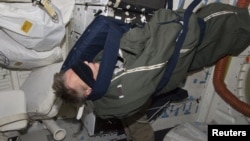
Astronaut Piers Sellers, STS-132 rests in his sleeping bag on the middeck of the space shuttle Atlantis in this photo provided by NASA and taken May 17, 2010.Astronaut Piers Sellers, STS-132 rests in his sleeping bag on the middeck of the space shuttle Atlantis in this photo provided by NASA and taken May 17, 2010.
x
Astronaut Piers Sellers, STS-132 rests in his sleeping bag on the middeck of the space shuttle Atlantis in this photo provided by NASA and taken May 17, 2010.
TEXT SIZE - +
VOA News
There is nothing like a regular sleep schedule to keep you healthy, especially on a long voyage to Mars.
 
On June 3, 2010, a six-man team of international volunteers was sealed into a 550-cubic-meter spacecraft-like compartment at a Russian Academy of Sciences facility to simulate a 520-day round-trip mission to the Red Planet.
 
During the project, sponsored in part by the European Space Agency, the 'crew' conducted experiments and scenarios to collect psychological and medical data on the effect of long-term deep-space flight.
 
Researchers from the University of Pennsylvania and Baylor College of Medicine analyzed the data in a study published in the journal Proceedings of the National Academy of Sciences.  They found that the crew became more sedentary as the months passed, and most of them also experienced a decrease in the quality of their sleep and alertness. 
 
Co-lead author Mathias Basner says that demonstrates the need to ensure that Earth's natural circadian rhythm is artificially simulated in future spacecraft and planetary habitats, so crew members can maintain a normal and healthy sleep-wake cycle. 
 
The findings are also applicable here on Earth, where many people in industrialized countries have sedentary lifestyles, as well as disrupted sleep patterns because of work and school schedules.  Co-lead author David Dinges notes "the human body's need for sleep is as essential as our need for food and water."

 

You May Like

South Africa to Host World's Biggest Telescope

South Africa competed against Australia to host the telescope, the final decision was to split the SKA between the two countries More

Report: Global Warming Could Reverse Development

World Bank study says warmer climates threaten advances and could exacerbate poverty in world’s poorest regions More

Video Inmates Fight Fires, Gain Skills for Life After Prison

In California, physically fit inmates with no history of violent crimes can train, work as firefighters while serving their time More

This forum has been closed.
Comment Sorting
Comments
     
by: Idonwanna Tellya
January 07, 2013 6:08 PM
Are my tax dollars going toward this study/project? If so, I think we have better things to do than play Buck Rogers... What a waste.

In Response

by: Rick from: Italy
January 10, 2013 1:03 PM
a small step for (a) man
a giant "sleep" for mankind

In Response

by: Mark Galvin from: Liverpool, UK
January 07, 2013 9:08 PM
Despite what some people may think, this is important research. By investigating the effects of long-term space missions on humans we can be much better prepared when the time actually comes.
In addition, this particular experiment is quite significant to me - I have a rare circadian rhythm condition called Hypernychthemeral Disorder (also known by the easier to spell "Non-24"), which means my body-clock isn't the usual 24-hours or so.
The effect to me is what it would be to you if Daylight Savings Time was added every single day, for the rest of your life, and never put back.
If this research leads to a way to alter circadian rhythms in mammals then I and the other sufferers of this and related conditions have hope of an effective treatment, or even a cure, and we may regain the quality of living that the rest of the world takes for granted.
So, even if tax dollars are going towards this project, no, it's not a waste, as it may lead to applications in unexpected areas, such as medicine.

Featured Videos

Your JavaScript is turned off or you have an old version of Adobe's Flash Player. Get the latest Flash player.
Video

Video Human Rights Film Festival Highlights Gender, Economic Issues

Twenty new films from around the world are screening in New York this week, as part of the 24th annual Human Rights Watch Film Festival, co-presented by the Film Society of Lincoln Center and IFC Center. The issues explored range from the rights of women, gays and the disabled, to economic justice, to political murder, torture and wrongful imprisonment. VOA’s Carolyn Weaver reports from New York.