



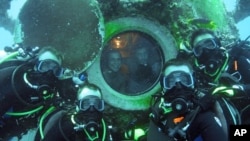
It is easy to conjure up images of astronauts working in space, but there are also astronauts living and working on the sea floor, where they conduct experiments to prepare for future space missions.
Canadian Space Agency astronaut Chris Hadfield has spent most of the past two weeks about 19 meters below the waves off the Florida coast. He is leading a two-week NASA mission aboard the Aquarius Underwater Laboratory, which is run by the U.S. National Oceanic and Atmospheric Administration.
Hadfield's team includes a NASA astronaut, an undersea engineer and a scientist. They live inside Aquarius, and they run experiments in the lab and explore the blue depths outside the porthole windows.
"I found that when I was working outside here over the last couple of weeks, I would suddenly notice where I am while I'm working. I'm busy working on some part of a space suit design, and then an angel fish goes by or a ray scuttles across the bottom of the ocean, and it reminds me of both the comfort-level I've gotten to and the amazing difference of where I am," he said.
Hadfield is on the sea floor inside the Aquarius underwater habitat's 122 square meters of living and working space. It is anchored next to a coral reef, five and half kilometers off Key Largo in the Florida Keys.
But even on the ocean floor, Aquarius is visible on the World Wide Web. Commander Hadfield can be seen via webcam on NASA's web site. He stands in a narrow white room with stainless steel equipment as he speaks to reporters using something that looks akin to a cordless phone.
It is the round window that looks out into the pale blue water that provides the biggest clue to Hadfield's whereabouts. The view might be serene, but the undersea environment is potentially deadly to humans, just as space is. Hadfield would know. He has completed two spacewalks in his 18 years as an astronaut, and he says there are similarities between working in space and in the sea.
"They are remarkably similar. You are wearing gear to protect you from an environment that would kill you. Every breath is amplified so you sound like [famed Star War's character] Darth Vader when you're out walking around out there. You're listening to help from someone inside the vehicle and someone back at mission control, as they try to help give you advice as you work on something complex outside," he said.
The crew has performed a series of activities outside Aquarius, similar to ones astronauts would perform in space. They use near-scale mockup vehicles and conduct off-loading, retrieval and survival missions.
Meanwhile, Hadfield is working to develop a more functional space suit that would allow astronauts to travel beyond the International Space Station. He says this task requires simulating gravity on the Moon, Mars and elsewhere.
"Of course, we are testing space suits for different levels of gravity. We want to be ready to explore an asteroid, which has almost no gravity. It's similar to a space walk on the space station. But how do you control where you are if you can't regularly grab on to man-made handholds or places to click in your feet?"
He says these underwater tests help astronauts figure out how much mass they need to propel themselves forward.
The crew and mission control have also experimented with communication delays, from the brief delay astronauts experience on the space station to the roughly 20-minute delay that could exist on Mars.
Crew members also study the ways their bodies react to extreme environments and changes in pressure by monitoring their heartbeats and using radar to chart their blood flow.
By the time the 14-day mission wraps Monday, the crew will have conducted a total of 52 so-called "space walks" in the sea.
At the end of the mission they will ascend to the water's surface over the course of about 16 hours, at a rate of roughly one meter per hour, so their bodies can adjust to the changes in pressure.
Watch a NASA Video on NEEMO and Other Exploration Field Tests