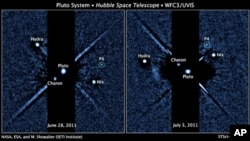



Astronomers have discovered a fourth moon orbiting the solar-system's distant dwarf-planet, Pluto. The speck of rock was spotted by the Hubble space telescope.
The new moon, so far known simply as "P4," is the tiniest of four satellites orbiting Pluto, a sphere of ice and rock smaller than Earth's moon that circles the Sun at a distance of more than five billion kilometers. P4 was discovered while astronomers were searching, unsuccessfully, for rings around Pluto, which lost its official ranking as the solar-system's ninth planet in 2006.
Mark Showalter, with the US space agency’s SETI Institute in Mountain View, California, led the team that discovered P4.
Showalter says that when scientists first observed the tiny moon in late June, astronomers thought P4 might be either Nix or Hydra, Pluto’s other smaller moons.
But further observations revealed that the object was a new moon, and an extremely small one - about 13 to 34 kilometers in diameter.
“The reason there’s such a big uncertainty [about] its size is that it all kind of depends on how bright the surface is," said Showalter. "If it’s a fairly bright surface, then it would be a smaller object. If it’s a fairly dark body, like some of the distant outer solar objects are very, very dark, then it would have to be the larger size. If you consider those are still remarkably small objects when you consider we are seeing it from three billion miles [4.8 Billion kilometers] away.”
Showalter says P4 is about 10 percent as bright as Nix, which was previously Pluto’s smallest moon.
Pluto and its largest satellite Charon, which is approximately one thousand kilometers in diameter, form one of two so-called binary systems in our solar system. The other is the earth-moon system.
Astronomers believe such double systems were created by massive planetary impacts more than four billion years ago when the solar system was formed. In the case of Earth, scientists believe a planet about the size of Mars collided with Earth to create our moon.
Showalter says the discovery of P4 suggests Pluto is a dynamic planetary system.
“And of course the mere fact that we have found something new raises the possibility that we should look even a little deeper to see what else might have been overlooked all these years," he said.
The latest discoveries set the stage for NASA’s New Horizons mission, which is scheduled to fly through the Pluto system in 2015.
Astronomers Discover New Moon Orbiting Pluto