



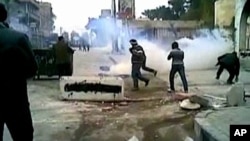
Activists say Syrian forces killed at least 32 people on Friday, as Arab League monitors visited more sites to check the government's compliance with a pledge to end its crackdown on dissent.
The opposition Local Coordination Committee of Syria says most of the deaths occurred after forces opened fire on anti-government protesters in several locations.
Activists and witnesses say hundreds of thousands of people rallied across Syria with renewed calls for President Bashar al-Assad's departure.
Meanwhile, the state-run SANA news agency displayed photos of flag-waving supporters of Assad at national unity rallies in cities, including Damascus and Homs.
The news agency also says a team of Arab League monitors visited neighborhoods in Hama, at one point stopping to meet with wounded patients at a hospital.
The news agency says separate teams visited Damascus suburbs and neighborhoods in the Homs region. About 60 observers are in the country.
Earlier Friday, Syria's ally, Russia, said it is "satisfied" with the initial results of the observer mission. The Foreign Ministry said in a statement that the situation in the restive city of Homs "seems to be reassuring," based on initial observer reports.
Also, the United Nations said it was critical that the observers be given "unhindered access and full cooperation" by the Syrian government.
Syria pulled some of its tanks from Homs and released about 800 prisoners. But opposition leader Burhan Ghalioun said the government continues to hold more than 100,000 people, "some of them in military barracks and aboard ships off the Syrian coast."
Syrian authorities agreed to the observers under international pressure and threats of Arab sanctions. The plan requires the government to give the monitors freedom of movement except for sensitive military sites.
The United Nations estimates 5,000 people have been killed since March in violence linked to Syria's unrest. Syria says armed terrorists are driving the revolt. It accuses them of killing 2,000 security personnel since March.
| Join the conversation on our social journalism site - Middle East Voices. Follow our Middle East reports on Twitter and discuss them on our Facebook page. |