War Crimes Suspect Karadzic Demands 'Reward' at Trial
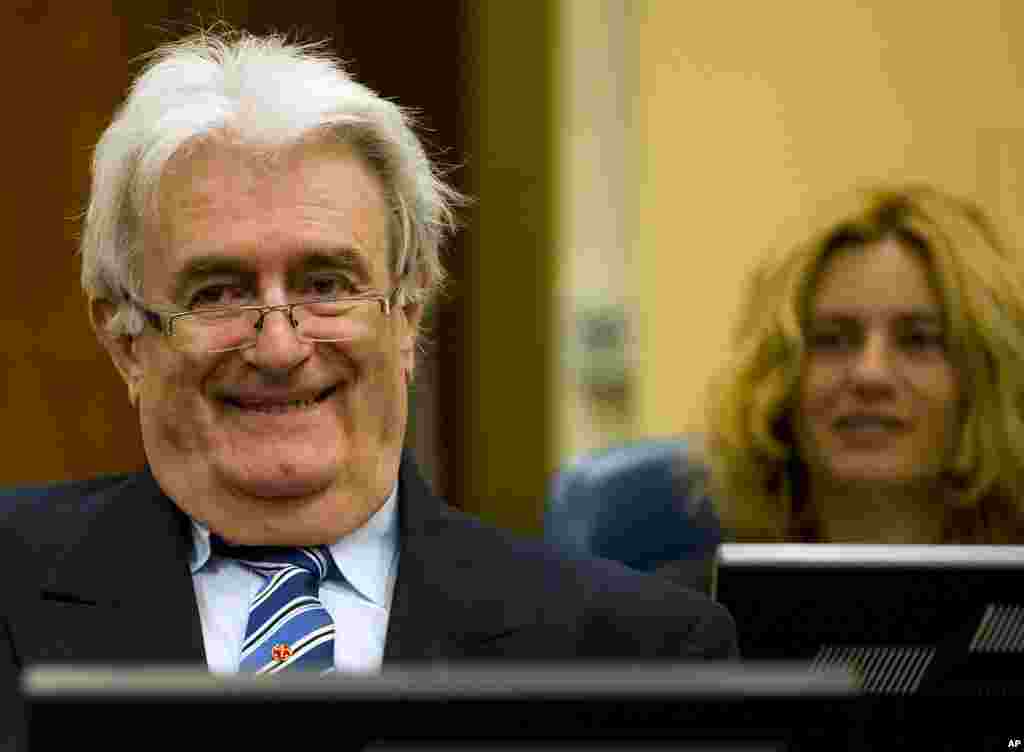
Suspected war criminal and former Bosnian Serb leader Radovan Karadzic smiles as he takes his seat on the defense bench in a courtroom to start his defense at the U.N. war crimes tribunal in The Hague, Netherlands, October 16, 2012.
BUDAPEST —
Former Bosnian-Serb leader Radovan Karadzic has denied responsibility for genocide and other war crimes, saying instead he should be rewarded for trying to avoid more bloodshed.
The words of a court official marked the beginning of the long anticipated defense by war-crimes suspect Radovan Karadzic, detained in 2008, after years on the run.
Karadzic began his defense Tuesday at the U.N. tribunal in The Hague.
Wearing a suit and appearing defiant, he introduced himself as a peace-loving "medical doctor, psychiatrist, psychotherapist, group analyst and writer," who could never have carried out atrocities during the Bosnian war of the early 1990s.
Though he was also president of the Bosnian Serbs at the time, Karadzic claimed he had been wrongly charged with genocide, war crimes and crimes against humanity.
He said that instead of being accused of events in the civil war, he should have been "rewarded," because, in his words, he "did everything within human power to avoid the war."
Trial of Radovan Karadzic
1/4Suspected war criminal and former Bosnian Serb leader Radovan Karadzic smiles as he takes his seat on the defense bench in a courtroom to start his defense at the U.N. war crimes tribunal in The Hague, Netherlands, Oct. 16, 2012.
Radovan Karadzic spent 13 years on the run after being indicted by the tribunal until he was found and arrested in Serbia in 2008.
Show moreShow less
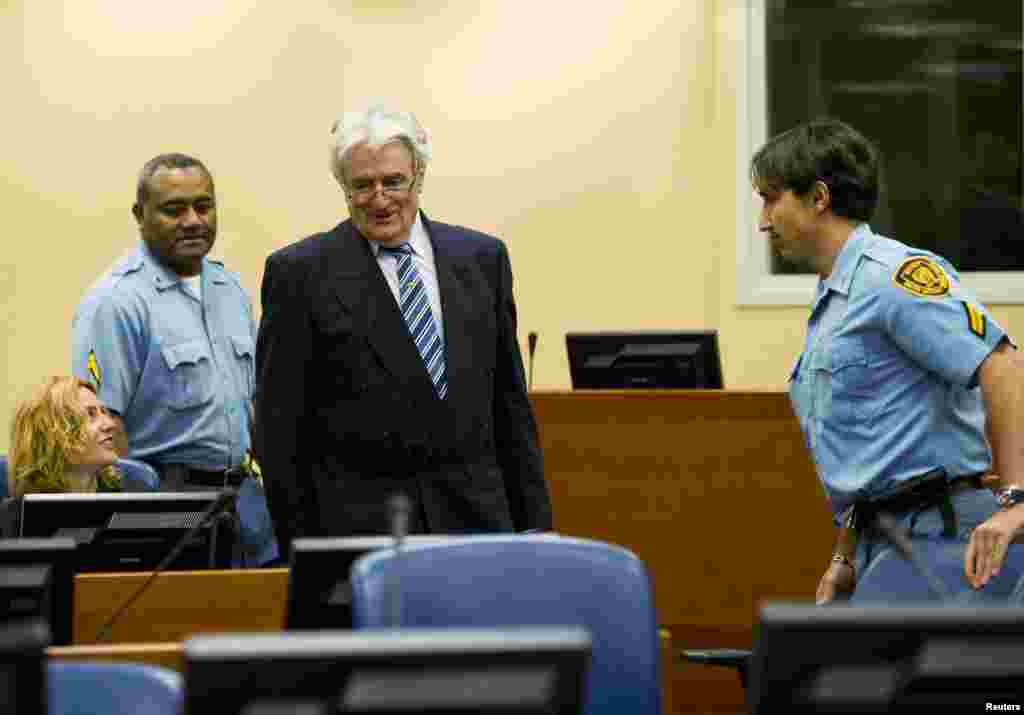
2/4Radovan Karadzic enters the courtroom on the first day of his defense against war crime charges at the International Criminal Tribunal for the Former Yugoslavia in The Hague October 16, 2012.
Radovan Karadzic spent 13 years on the run after being indicted by the tribunal until he was found and arrested in Serbia in 2008.
Show moreShow less
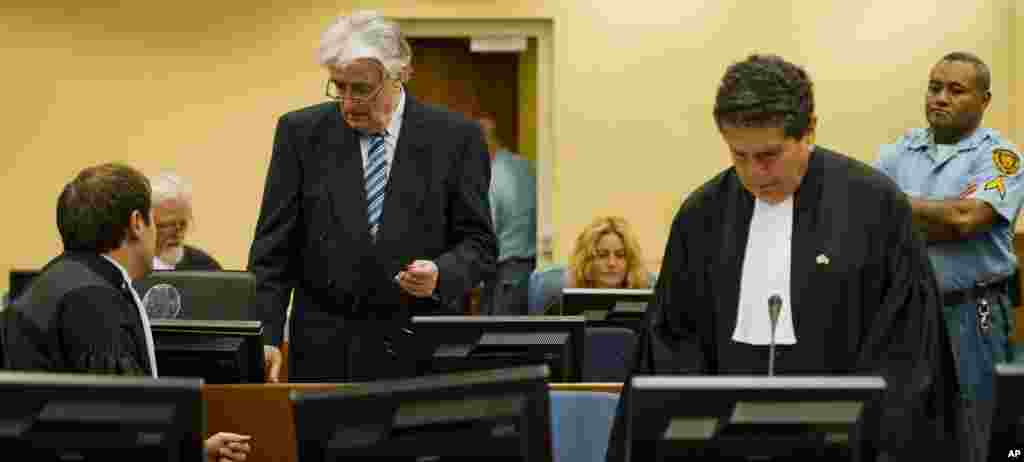
3/4Radovan Karadzic, standing at left, talks to Marko Sladojevic, left, a member of his legal team while his legal advisor Peter Robinson, right, prepares ahead of the start of Karadzic's defense.
Radovan Karadzic spent 13 years on the run after being indicted by the tribunal until he was found and arrested in Serbia in 2008.
Show moreShow less
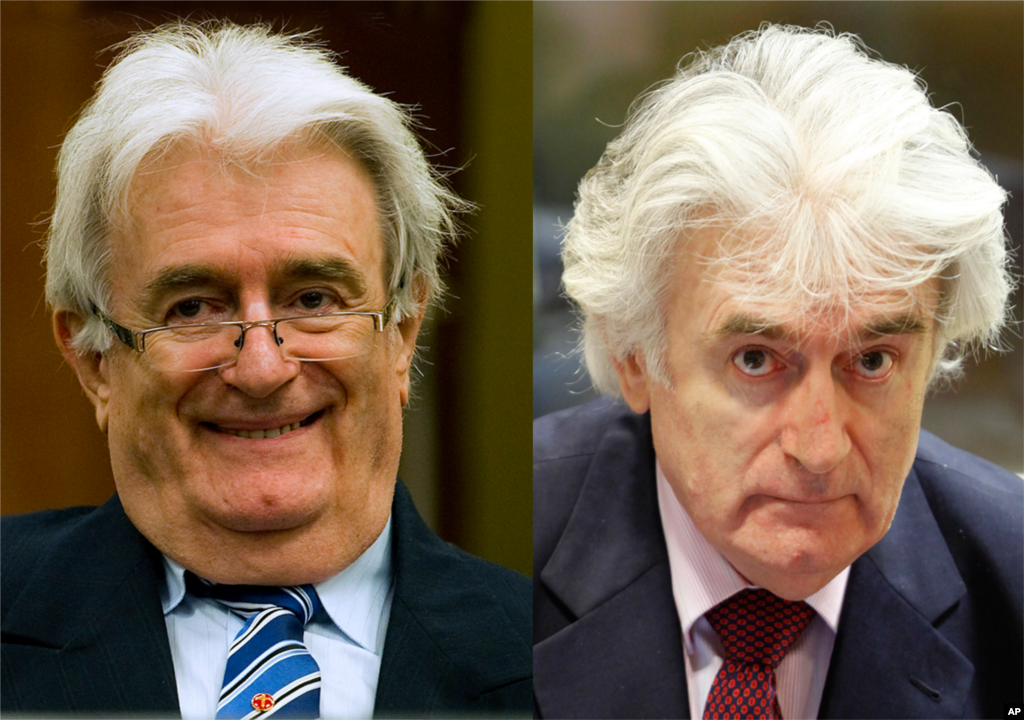
4/4The photo of Radovan Karadzic on the left was taken on October 16, 2012 while the photo on the right was taken during his earlier trial in November of 2009. The contrast in his appearance from three years ago is apparent in this photo.
Radovan Karadzic spent 13 years on the run after being indicted by the tribunal until he was found and arrested in Serbia in 2008.
Show moreShow less
Previous slide
Next slide
Karadzic did not appear disturbed by cries of "He is lying! He is lying!" from some Muslim survivors of the three-year war that left more than 100,000 people dead.
In an extensive statement, he denied involvement in several atrocities, including the 1995 massacre of 8,000 Muslim men and boys by Bosnian-Serb forces in the Bosnian town of Srebrenica.
Karadzic said he heard about what has been described as Europe's worst single atrocity since World War Two, but said he was not able to conclude an investigation because he was forced to step down as president.
He also addressed the siege of the Bosnian capital, Sarajevo, by Serb troops. He said Muslims faked the circumstances of the shelling of a marketplace in February 1994 that killed 68 people and injured 144 others and another similar attack.
He claimed that for his forces it would have been "impossible to reach that area and cause so much damage." He said "it was a scandalous orchestration" by Muslim fighters to blame Serbs. Karadzic called a Russian colonel, Andrej Demurenko, as a witness, to back up his claims that Bosnian-Serb forces could not have fired the shell.
But Karadzic acknowledged Serb snipers were used in Sarajevo during the Bosnian war.
He said he always found "snipers horrible and inhuman," but "using them was a legal military method to eliminate the enemies."
As Karadzic opened his defense, the tribunal also began a separate trial of its last suspect, Goran Hadzic, who is accused of murder, torture and forcible deportation. He allegedly oversaw these atrocities while president of the self-proclaimed Republic of Serbian Krajina in Croatia.
The U.N. court is under pressure to close in 2014, after paving the way for a permanent war crimes court.