


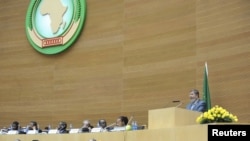
ADDIS ABABA — Africa leaders meeting at the African Union summit in Addis Ababa have approved a new $280 million budget to finance the AU's operations in 2013. Much of the budget is financed by foreign partners and the AU is considering new strategies to become more self-reliant, including imposing continent-wide levies.
AU Economic Affairs Commissioner Maxwell Mkwezalamba told reporters Monday that out of $160 million set aside for programs in next year's budget, more than 96 percent will be financed by the institution's global partners.
He says this funding structure has hampered the AU's efforts to implement its own programs.
“Obviously, this is a challenge for our continental organization because the resources coming from partners would have, kind of, strings attached, they would want to fund certain programs and therefore it means the others would suffer,” says Mkwezalamba.
The commissioner says donor partners sometimes fail to live up to their obligations, leaving the AU strapped for funding.
African leaders at the AU assembly are discussing three alternative funding options, as laid out in a implementation panel report.
Mkwelamba says one of the options is a tax on airline tickets.
“So, if you're traveling outside Africa, or coming inside Africa, there would be a small levy,"he says. But I mean this has not yet been adopted, but this is just what's being proposed. In fact, the amount that they are proposing is five dollars per ticket, and I believe this is not much.”
The other proposals are a $2 hospitality tax that would be added to hotel bills and a to-be-determined tax on text messages, which Mkwelamba admits is an unpopular option.
He says discussions with member states about these proposals has not been very easy because of concerns about the impact on local economies.
African Union members already contribute annual dues to the organization. The majority of contributions come from five of the continent's biggest economies: Algeria, Egypt, Libya, Nigeria and South Africa.
AU Economic Affairs Commissioner Maxwell Mkwezalamba told reporters Monday that out of $160 million set aside for programs in next year's budget, more than 96 percent will be financed by the institution's global partners.
He says this funding structure has hampered the AU's efforts to implement its own programs.
“Obviously, this is a challenge for our continental organization because the resources coming from partners would have, kind of, strings attached, they would want to fund certain programs and therefore it means the others would suffer,” says Mkwezalamba.
The commissioner says donor partners sometimes fail to live up to their obligations, leaving the AU strapped for funding.
African leaders at the AU assembly are discussing three alternative funding options, as laid out in a implementation panel report.
Mkwelamba says one of the options is a tax on airline tickets.
“So, if you're traveling outside Africa, or coming inside Africa, there would be a small levy,"he says. But I mean this has not yet been adopted, but this is just what's being proposed. In fact, the amount that they are proposing is five dollars per ticket, and I believe this is not much.”
The other proposals are a $2 hospitality tax that would be added to hotel bills and a to-be-determined tax on text messages, which Mkwelamba admits is an unpopular option.
He says discussions with member states about these proposals has not been very easy because of concerns about the impact on local economies.
African Union members already contribute annual dues to the organization. The majority of contributions come from five of the continent's biggest economies: Algeria, Egypt, Libya, Nigeria and South Africa.