Africa’s top peace and security body has decided to name a panel of five heads of state to negotiate a binding solution to the political standoff in Ivory Coast.
A heads of state-level meeting of the African Union Peace and Security Council has developed a formula for settling the leadership crisis that has paralyzed Ivory Coast since the November presidential runoff election.
After a late night session, AU Commission Chairman Jean Ping said a high-level panel would be named to come up with a legally-binding settlement of the dispute between incumbent President Laurent Gbagbo and opposition candidate Alassane Ouattara.
AU spokesman Noureddine Mezni explained the terms of the formula.
"The panel will be composed of at the level of heads of state. Named in 48 hours, supported by team of experts. The panel is mandated to evaluate the situation and formulate on the basis of the relevant decision of AU and ECOWAS and other political crisis exit plan," he said.
Mezni said in addition to five heads of state, one from each region of Africa, the panel would include a representative of the African Union and the west African regional group known as ECOWAS.
"The panel will conclude its work within a period not exceeding one month, and its conclusion, which will be endorsed by the Council will be binding on all the Ivorian parties with which this conclusion would have been negotiated," he said.
It was not immediately clear whether the parties to the dispute would accept the Peace and Security Council proposal. Mr. Gbagbo previously rejected mediation efforts by Kenyan Prime Minister Raila Odinga, who had been appointed by the African Union to help settle the leadership crisis.
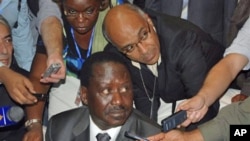
Mr. Odinga also attended Friday’s meeting. He urged heads of state gathering for an African summit to send a strong message that the Ivorian parties must settle their differences through face-to-face negotiations. At the same time, he expressed regret at what seems to be a developing trend in Africa of subverting the will of the people as expressed in elections.
"Cote d’Ivoire symbolizes the great tragedy that seems to have befallen Africa, whereby some incumbents are not willing to give up power if they lose," he said. "This refusal is particularly egregious in Cote d’Ivoire’s case, since never has there been such internal, regional and international unanimity among independent institutions about the outcome of a disputed election in Africa."
Mr. Odinga was widely regarded as the winner of Kenya’s disputed 2007 election, but became prime minister after a power sharing deal was struck with President Mwai Kibaki. Zimbabwe’s President Robert Mugabe, who participated in Friday’s Peace and Security Council decision, also kept power through a negotiated agreement after an apparent electoral defeat.
Mr. Odinga called such negotiations damaging to democracy.
"Africa will never have a stable political base unless we internalize the democratic culture of ceding power after losing in a competitive electoral process," he said. "If one’s vote does not count in determining who will lead a nation, which is the most elemental dimension of democracy, elections will become meaningless, democracy will lose its luster, and the future will be riddled with widespread unrest and instability."
Five heads of state participated in Friday’s special Peace and Security Council meeting. In addition to Mr. Mugabe, South African President Jacob Zuma and Nigerian President Goodluck Jonathan were there, along with the leaders of Namibia and Mauritania.
An spokesman said AU Commission Chairman Ping would be the continental body’s representative on the high-level settlement panel.
AU to Name Heads of State Panel to Settle Ivory Coast Leadership Dispute