



Click here to see Burma Events Timeline
Burma's military government released democracy leader Aung San Suu Kyi from house arrest Saturday after her current term of detention expired. Her release comes days after a military-backed party claimed to win Burma's first elections in two decades.
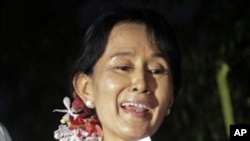
Hundreds of Aung San Suu Kyi's supporters gathered outside her house in Rangoon Saturday to welcome her release.
She briefly addressed the crowd, telling them she will speak again Sunday at her National League for Democracy headquarters.
Aung San Suu Kyi walked free after spending most of the past 20 years locked up.
Burma's military government has detained her on and off, mostly in her house, since 1989.
Khin Ohmar is coordinator of the Burma Partnership, a coalition advocating democracy in Burma. She says the military government is afraid of Aung San Suu Kyi's influence.
"She is, in their eyes, she is the enemy of the state," she said. "She is the major threat to their power because she is the one who is trusted by the whole country, who is trusted by the people."
Aung San Suu Kyi was awarded the Nobel Peace Prize in 1991 for her efforts to bring democracy to Burma. She is widely beloved in Burma and seen as a global icon of peaceful resistance against injustice.
Her latest term of house arrest was for allowing an uninvited American man last year to stay overnight without permission.
It expired on Saturday, just a few days after a military-backed party claimed victory in Burma's first election in two decades.
Critics say the military, which has ruled for five decades, designed the election so it could stay in power. The government says the election was a key step toward a civilian government.
Aung San Suu Kyi's National League for Democracy won Burma's last elections in 1990 by a landslide but the military ignored the results.
She was banned from contesting the polls. The NLD boycotted the election because of that and other rules the party considered unfair.
The government disbanded the NLD because of its boycott and it now operates as a social charity.
Aung San Suu Kyi has said she will investigate opposition complaints of voter fraud in the elections.
Some of her supporters worry any political activity could give the government an excuse to throw her back in detention.
Burma's government is considered one of the most repressive in the world. The military, however, says it must keep a firm grip to prevent ethnic minority militias from trying to split the nation.