



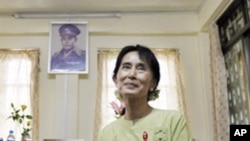
Nobel Peace laureate Aung San Suu Kyi has wasted little time slipping back into her role as Burma's most outspoken democracy activist since being released from house arrest last week.
In her first week of freedom, Aung San Suu Kyi has called for reconciliation talks with military leader General Than Shwe. But she said in an interview with the Associated Press Thursday that the government has not contacted her.
Some analysts have suggested Burma's military rulers freed the opposition leader for public relations purposes, to lend credibility to recent elections and a civilian-led parliament. In her interview, Aung San Suu Kyi declined to speculate why the military government permitted her release.
"I don't think there was any other reason for releasing me rather than one the legal term of detention had come to an end, and there were no immediate means of extending it," she said.
Aung San Suu Kyi called her house arrest illegal. Still, the 65-year-old said she does not regret staying in Burma, rather than avoiding detention by going to England to be with her family.
"I made a choice, and when I made the choice, I knew that there would be problems," she said. "If you make a choice, then you have to be prepared to accept the consequences. I think I believe a lot in accountability and a sense of responsibility."
Aung San Suu Kyi chose to to take up the democracy struggle in 1988, when mass demonstrations broke out against nearly three decades of military rule. As the daughter of Burma's independence leader from Britain, Aung San Suu Kyi was quickly seen as being one with the people, and democracy activists adopted her as their leader.
A year later, the military detained her, and kept her under house arrest until 1995. She chose to stay in Burma for fear she would not be let back in. She was detained again in 2003.
By choosing the role of democracy activist, she gave up the role of mother. In her interview Thursday, Aung San Suu Kyi reflected on that decision.
"My sons are very good to me. They haven't done very well after the breaking up of the family, especially after their father died because Michael was a very good father," she said.
Despite the personal challenges, Aung San Suu Kyi said she will not change her political agenda.
"I'd better go on living until we have a democratic Burma," she said.
Since her release, Aung San Suu Kyi has been careful not to call for an overthrow of the government, but she has also not wavered in her demand for a change.