



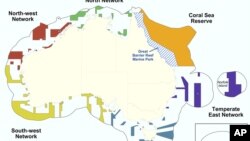
Australia is to create the world's largest network of marine parks. The sanctuaries will cover 3.1 million square kilometers of ocean, including the Coral Sea, off the country’s northeast coast. There will be restrictions on fishing and oil and gas exploration in protected zones.
The marine reserves cover more than a third of Australia’s territorial, waters covering an area as large as India. Oil and gas drilling will be outlawed in in all marine national parks, while commercial fishing will be limited in some of the most sensitive areas.
Australia’s announcement coincides with the build-up to the Rio+20 Earth Summit next week in Brazil - a gathering of international leaders from more than 130 nations who will discuss protecting key parts of the environment.
Last year Canberra said the new laws were to protect marine life in Coral Sea, off the Queensland coast, which is home to sharks, remote tropical reefs and deep-sea canyons.
Environment Minister Tony Burke says the new scheme will provide comprehensive protection for vast areas of the country’s territorial waters.
"This is the largest network of marine reserves anywhere in the world," he said. "What we've done is effectively create a national parks estate in the ocean. But, I think the jewel in the crown in the whole thing would have to be the Coral Sea. And, this is the area that sort of extends out from the Great Barrier Reef marine park right to the edge of Commonwealth waters.
And, people were saying well, we've protected a lot of the Coral Sea in our proposal, but people are asking us to really push the boundaries and cover some more reefs."
The Australian Conservation Foundation says the reserves initiative was "a historic achievement," but it has attracted immediate criticism from other environmental and lobby groups.
The fishing industry says the plan will devastate many coastal communities. Burke says the government will consult with fishermen about compensation.
The Greens, however, accused the government of bowing to pressure from the energy sector when drawing up the reserves’ boundaries and insist that the new system did not go far enough to protect marine mammals from the impact of oil and gas exploration in many areas.
A final consultation period of 60 days is now scheduled with the new reserves expected to be officially sanctioned before the end of the year.
The marine reserves cover more than a third of Australia’s territorial, waters covering an area as large as India. Oil and gas drilling will be outlawed in in all marine national parks, while commercial fishing will be limited in some of the most sensitive areas.
Australia’s announcement coincides with the build-up to the Rio+20 Earth Summit next week in Brazil - a gathering of international leaders from more than 130 nations who will discuss protecting key parts of the environment.
Last year Canberra said the new laws were to protect marine life in Coral Sea, off the Queensland coast, which is home to sharks, remote tropical reefs and deep-sea canyons.
Environment Minister Tony Burke says the new scheme will provide comprehensive protection for vast areas of the country’s territorial waters.
"This is the largest network of marine reserves anywhere in the world," he said. "What we've done is effectively create a national parks estate in the ocean. But, I think the jewel in the crown in the whole thing would have to be the Coral Sea. And, this is the area that sort of extends out from the Great Barrier Reef marine park right to the edge of Commonwealth waters.
And, people were saying well, we've protected a lot of the Coral Sea in our proposal, but people are asking us to really push the boundaries and cover some more reefs."
The Australian Conservation Foundation says the reserves initiative was "a historic achievement," but it has attracted immediate criticism from other environmental and lobby groups.
The fishing industry says the plan will devastate many coastal communities. Burke says the government will consult with fishermen about compensation.
The Greens, however, accused the government of bowing to pressure from the energy sector when drawing up the reserves’ boundaries and insist that the new system did not go far enough to protect marine mammals from the impact of oil and gas exploration in many areas.
A final consultation period of 60 days is now scheduled with the new reserves expected to be officially sanctioned before the end of the year.