



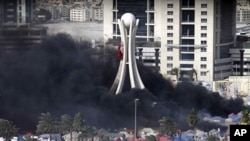
Security forces in Bahrain have retaken control of a main demonstration site in the capital Manama where anti-government protesters had been camping for weeks.
Soldiers and riot police used armored vehicles and tear gas to disperse crowds at Pearl Square on Wednesday and witnesses say the site was cleared in about two hours. At least two people were reportedly killed in the latest clashes adding to two other deaths confirmed on Tuesday. Hospital workers say hundreds of other people have been wounded in fighting around the country some by gunfire.
The crackdown came one day after the Persian Gulf Kingdom declared a three-month state of emergency.
Troops from neighboring Saudi Arabia were deployed to Bahrain on Monday to help reinforce local authorities, however, it is unclear whether they were involved in the operations at Pearl Square.
Other Gulf Arab states have promised military support.
Protesters from Bahrain's majority Shi'ite population have been demanding political reforms and say they are treated like second-class citizens by the minority Sunni government.
The ruling al-Khalifa family has offered to hold a dialogue with opposition groups. But some protesters are demanding more power for parliament and that the royal family be ousted.
An increasing number of sectarian clashes have been reported in Bahrain since demonstrations began over a month ago.
Director of the Brookings Doha Center, Salman Shaikh, believes the unrest could spill over into neighboring countries, especially Saudi Arabia, which has a ruling Sunni family, but a majority Shi’ite population in its eastern provinces.
"If the situation in Bahrain escalates, I would guess that we would get these provinces to further rise [in protest], some are even speculating that we could have an arch of fire stretching and spreading from Bahrain to the eastern provinces of Saudi Arabia," he said.
Iran, the region’s predominantly Shi’ite power, has criticized the deployment of foreign troops to Bahrain. Middle East analyst at IHS Global Insight Gala Riani believes the country could play a larger role in the Arab conflict in the future.
"If sectarian unrest continues and is ignited in Saudi Arabia and Bahrain and continues for a longer period of time it is possible that some more hard-liner groups would somehow seek some degree of clandestine support from Iran," said Riani. "Iran has shown that elsewhere in the Middle East it has supported groups with weaponry or training or other types of assistance.
The U.S. State Department is warning Americans against travel to Bahrain and advising citizens in the Gulf state to consider leaving.