


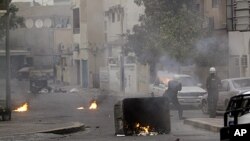
A controversial former U.S. police chief hired as an adviser to reform Bahrain's security forces has defended the use of tear gas in residential neighborhoods to control mounting unrest surrounding the first anniversary of the country's pro-democracy uprising.
Raids on Shi'ite villages have intensified in recent days, with residents complaining of tear gas attacks on a nightly basis. Tear gas has been blamed for several recent deaths.
Shi'ite Muslims make up the majority of Bahrain's opposition and say they receive ill treatment from the nation's Sunni rulers. They have been calling on the government to stop tear gas strikes in their neighborhoods.
But John Timoney, a former police chief of Philadelphia and Miami now advising Bahraini authorities on security tactics, says a sharp rise in violent attacks by activists is forcing officers to respond.
"Police have been using tear gas to create distance between them and gangs of rioters that have been on a very steady basis, day after day, assaulting police officers with Molotov cocktails and also with bricks, nails and other things," he noted.
According to the government, activists injured more than 40 officers in the run-up to the February 14 pro-democracy anniversary. Several were hospitalized. Timoney says police are trying to respond with non-lethal means.
"While tear gas unfortunately does impact on people who are not involved, at the end of the day, it's a more desirable weapon than, for example, using live rounds to defend yourself," he added.
Timoney, who gained a reputation for cracking down on protests in the U.S., also dismissed claims by activists that authorities in the Persian Gulf Kingdom had begun using toxic gases on citizens.
"We have thousands of police officers out there on a daily basis. They are smelling and touching that gas themselves. We've had nobody come in with poison or respiratory problems," Timoney noted.
Bahrain's mainly Shi'ite protesters took to the streets a year ago to demand more rights and a more representative government
However, their calls were silenced a month later after troops from Saudi Arabia and the United Arab Emirates were deployed to the country and a three-month state of emergency was imposed.
Timoney, along with former assistant commissioner of Britain's Metropolitan Police John Yates, were hired to help implement some recommendations of the Bahrain Independent Commission of Inquiry (BICI) report, released last November, that pertain to the nation's security forces. The report said Bahraini authorities had used excessive force and torture during the initial months of the pro-democracy unrest last year.
Jamal Fakhro, a senior member of Bahrain's parliament, says the two international police advisers are helping with security reform.
"They are changing a lot in the culture of the Ministry of Interior [and] with the police," said Fakhro. "They are bringing in the best practices and they are laying down responsibilities."
But others, like Radhi Mohsen al-Mosawi, deputy secretary general for political affairs at the opposition party Wa'ad, say the appointment of Western officials is a public relations stunt.
Al-Mosawi says recent YouTube video showing officers beating civilians and throwing burning objects onto houses prove that officers continue to carry out illegal practices.
He says that according to rights groups, more than 30 people have been killed since the BICI inquiry report was issued.
"These experts should understand that Bahraini people are not crazy to believe what they say," said al-Mosawi.
Al-Mosawi says Bahrain's leaders should put more focus on other recommendations of the independent inquiry, such as creating the right conditions for a national dialogue.
"Our problem is politics and should be between Bahrainis. And I don't think these experts will solve the problem," added al-Mosawi.
Opposition groups in Bahrain pulled out of official talks with the government last year after saying they received "unfair representation" in them.