



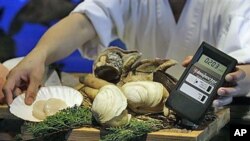
The number of governments that have banned Japanese food imports due to fears of radiation contamination is growing. On Friday, China joined Singapore and the U.S. in halting some imported foods from radiation-affected areas of Japan. Other governments are expected to take similar precautionary measures as Japan struggles to contain the damage from the Fukushima nuclear plant.
The situation at the crippled Fukushima nuclear plant remains precarious after several workers there suffered radiation burns while attempting to cool one of the damaged reactors.
Although the extent of contamination remains unclear, the damage to farms and livelihoods is spreading. At one of Japan's busiest fish markets, Yasumichi Tanaka said the daily catch is dwindling. "Fish supplies from the radiation contaminated regions have been totally halted."
Produce markets also have taken a hit. Retailers say some customers are avoiding all vegetables, not just those likely to be contaminated.
International orders have suffered, as well.
On Friday, China joined the growing list of countries that have halted food imports from affected regions. State TV reported the banned items included milk products, fruit, vegetables and seafood.
In Singapore, where some Japanese foods already are banned, restaurant manager Connie Hon said her customers are worried. "Consumer confidence is yes, somewhat shaken, I would say, amongst some of the Singapore populace, but that can't be helped, I think."
And at another popular restaurant, manager Nakakita Yoshihiko said the menu has changed. "First of all, they want to know the food comes from where and is it safe or not? These are two major questions and it's very easy to answer. It does not come from Fukushima, and Singapore is able to check all the items to make sure the food is safe."
Canada, Australia and Russia have adopted similar bans on Japanese foods. Health and security researcher Bill Durodie said more countries are likely to follow. "The reality is the United States made the decision a few days ago and it's almost inevitable that once a country that size has decided to act in that way, others will follow suit."
But an expert on the politics of energy said the danger of radiation-contaminated foods is greatly exaggerated. Charles Ebinger at the Brookings Institution told VOA that an average adult would have to drink a quart of contaminated milk each day for one year to receive the same radiation as one CAT scan.
Ebinger said the one certainty is the economic damage to Japan's northeast. "That particular part of Japan is deeply dependent on agriculture and fish, so I think inside the Japanese economy, we'll see pockets of areas that have been exposed to contamination, see their economy hurt very much."
Many European countries have yet to announce bans on Japanese food imports. Germany and France have started screening food samples. They say there will be no restrictions on Japanese food imports, however, until the test results are back.