


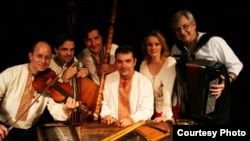
To see Harmonia founder Walt Mahovlich at work with his band, Harmonia, is to see a man passionate about music from the so-called old country. It's a love that developed during his Cleveland childhood decades ago, when his Hungarian mother and Croatian father exposed him to the music at home, in taverns, on picnics and at weddings.
Today, he's on a mission to spread its joy with a nine-member Eastern European folk ensemble from Cleveland that has released a new CD, “Hidden Legacy.” .
“Number one, I would like people to know that our music represents America and the American experience as much as anything," Mahovlich says. "We certainly want people frankly to enjoy it and to share in the exuberance and passion of this music. We don’t want it to be remain hidden.”
Today, the cultural traditions of Cleveland’s Hungarians, Serbs, Croats, Ukrainians, Slovaks, Romanians and other Eastern Europeans aren't widely known.
But a half century ago, the city's Buckeye Road district specialized shops and eateries with storefront signs in several languages. Mahovlich says one could sometimes tell the old timers’ country of origin by the way they dressed. Today, he says, one must peer inside church basements, taverns and dancehalls for a glimpse into another world.
“You go through that door and suddenly you are at a party that might feel like you are in rural Western Ukraine, or you might go into a bar and suddenly you might as well be in Zagreb or Novi Sad in Croatia or Serbia," he says. "Or you drive down a country road and suddenly you are smelling roasted lambs or Hungarian goulash and you are hearing this music that you might as well be someplace in Hungary or Slovakia.”
Alex Fedoriouk, a conservatory graduate, plays the cimbalom, a 125-string hammer dulcimer that resembles the innards of a grand piano.
In Ukraine, he often traveled with a cimbalom strapped to his back to reach weddings in remote mountain villages. Sometimes the parties would last for days. Today, Fedoriouk plays the cymbalom as part of Harmonia.
"Some of the songs we play, they’ve been played hundreds and hundreds, maybe thousands of years ago," Fedoriouk says, "and they have been refined and polished and changed just a little bit, and it’s such a pure form. "
Music can have other uses than entertainment. Mahovlich says one ancient melody performed by Harmonia was once played by gypsies all over Romania.
"The men would dance very vigorously to this music to bring health, fertility, happiness, and drive away evil spirits from the village," he says.
However, the meaning has changed.
"We don't live in villages in the United States," Mahovlich says. "So the meaning of this music has changed. The meaning now is that this shows we are Romanians. We will teach our kids how to do it. It's a symbol of who we are."
Harmonia uses rarely-heard instruments such as the “fujura, a two-meter long shepherd’s flute that Brano Brinarsky brought here from the Slovakian highlands.
Many consider the human voice to be Eastern Europe's instrument par excellence, and Harmonia’s Slovakia-born Beata Begeniova, who sings in six languages, expresses a wide range of emotion with her voice.
Mahovlich says for many years, mainstream Americans felt ethnic music was backward, and sometimes immigrants were made to feel embarrassed about performing it in public.
But he's heartened by how Harmonia’s music has been embraced by young people, along with the usual fans, at recent concerts.
"And it was so nice to see a crowd that consisted of college students, art students, old ‘babas’ - old grandmothers - wearing headscarves and even some businessmen, all together in the same place. They found it new and electrifying. We're all Americans.”
Today, he's on a mission to spread its joy with a nine-member Eastern European folk ensemble from Cleveland that has released a new CD, “Hidden Legacy.” .
“Number one, I would like people to know that our music represents America and the American experience as much as anything," Mahovlich says. "We certainly want people frankly to enjoy it and to share in the exuberance and passion of this music. We don’t want it to be remain hidden.”
Today, the cultural traditions of Cleveland’s Hungarians, Serbs, Croats, Ukrainians, Slovaks, Romanians and other Eastern Europeans aren't widely known.

But a half century ago, the city's Buckeye Road district specialized shops and eateries with storefront signs in several languages. Mahovlich says one could sometimes tell the old timers’ country of origin by the way they dressed. Today, he says, one must peer inside church basements, taverns and dancehalls for a glimpse into another world.
“You go through that door and suddenly you are at a party that might feel like you are in rural Western Ukraine, or you might go into a bar and suddenly you might as well be in Zagreb or Novi Sad in Croatia or Serbia," he says. "Or you drive down a country road and suddenly you are smelling roasted lambs or Hungarian goulash and you are hearing this music that you might as well be someplace in Hungary or Slovakia.”
Alex Fedoriouk, a conservatory graduate, plays the cimbalom, a 125-string hammer dulcimer that resembles the innards of a grand piano.
In Ukraine, he often traveled with a cimbalom strapped to his back to reach weddings in remote mountain villages. Sometimes the parties would last for days. Today, Fedoriouk plays the cymbalom as part of Harmonia.
"Some of the songs we play, they’ve been played hundreds and hundreds, maybe thousands of years ago," Fedoriouk says, "and they have been refined and polished and changed just a little bit, and it’s such a pure form. "
Music can have other uses than entertainment. Mahovlich says one ancient melody performed by Harmonia was once played by gypsies all over Romania.
"The men would dance very vigorously to this music to bring health, fertility, happiness, and drive away evil spirits from the village," he says.
However, the meaning has changed.
"We don't live in villages in the United States," Mahovlich says. "So the meaning of this music has changed. The meaning now is that this shows we are Romanians. We will teach our kids how to do it. It's a symbol of who we are."
Harmonia uses rarely-heard instruments such as the “fujura, a two-meter long shepherd’s flute that Brano Brinarsky brought here from the Slovakian highlands.
Many consider the human voice to be Eastern Europe's instrument par excellence, and Harmonia’s Slovakia-born Beata Begeniova, who sings in six languages, expresses a wide range of emotion with her voice.
Mahovlich says for many years, mainstream Americans felt ethnic music was backward, and sometimes immigrants were made to feel embarrassed about performing it in public.
But he's heartened by how Harmonia’s music has been embraced by young people, along with the usual fans, at recent concerts.
"And it was so nice to see a crowd that consisted of college students, art students, old ‘babas’ - old grandmothers - wearing headscarves and even some businessmen, all together in the same place. They found it new and electrifying. We're all Americans.”