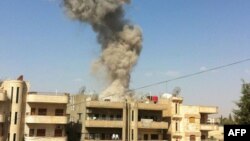
Syria's civil war appeared to widen to the country's mainly Kurdish northeast on Sunday, with a suicide car bomber killing several people in a rare attack on a Syrian Kurdish town near the Turkish border.
Syrian state media said at least four people were killed in the blast in Qamishli, while the British-based Syrian Observatory for Human Rights said the bomber killed eight Syrian security personnel near a government security compound.
It was the first such attack in the predominantly-Kurdish area since the outbreak of the 18-month Syrian uprising against President Bashar al-Assad's autocratic rule. Syrian Kurds largely have stayed out of the conflict. There was no independent confirmation of the casualties from the bombing because Syria restricts reporting by international journalists.
Aleppo violence continues
Also Sunday, Syrian activists reported another day of intense fighting in the northern city of Aleppo, with Syrian troops shelling rebel-held districts and rebels attacking the military's Al-Nairab air base.
An earlier round of fighting late Friday into early Saturday sparked a major fire in Aleppo's historic covered market, or souk. Activists said the fire destroyed hundreds of shops by Sunday, ruining the livelihoods of centuries-old family businesses selling fabrics, perfumes and spices.
The souk is located in Aleppo's walled old city, a UNESCO World Heritage Site that had been popular with tourists before the outbreak of the conflict. UNESCO says the fighting already has damaged five of Syria's six world heritage sites.
Turkey: 'stop supporting Assad'
In other developments, Turkish Prime Minister Recep Tayyip Erdogan called on Iran, Russia and China to stop supporting the Assad government. Speaking Sunday, he said "history will not forgive those who stand with brutal regimes."
Iran is Syria's strongest regional ally. Western and Sunni-led Arab states have accused Tehran of providing military aid to Mr. Assad.
Iraqi Foreign Minister Hoshyar Zebari told London-based Arabic newspaper Al-Hayat that Baghdad plans to conduct random inspections of Iranian planes flying to Syria through Iraqi airspace. In the interview published Sunday, Zebari said Iraq agreed to start the stop and search program at the request of the United States.
In a separate report sent to the media Sunday, the U.N. Office for the Coordination of Humanitarian Affairs said the number of Syrian refugees in Iraq, Jordan, Lebanon and Turkey could increase from the current figure of at least 300,000 to more than 700,000 by the end of this year.
OCHA said the number of Syrians in need of assistance is likely to rise with the winter season approaching and night temperatures already starting to fall significantly. It said tens of thousands of internally-displaced Syrians are staying temporarily in buildings that are "completely unsuitable" for the cold.
Syrian state media said at least four people were killed in the blast in Qamishli, while the British-based Syrian Observatory for Human Rights said the bomber killed eight Syrian security personnel near a government security compound.
It was the first such attack in the predominantly-Kurdish area since the outbreak of the 18-month Syrian uprising against President Bashar al-Assad's autocratic rule. Syrian Kurds largely have stayed out of the conflict. There was no independent confirmation of the casualties from the bombing because Syria restricts reporting by international journalists.
Aleppo violence continues
Also Sunday, Syrian activists reported another day of intense fighting in the northern city of Aleppo, with Syrian troops shelling rebel-held districts and rebels attacking the military's Al-Nairab air base.
An earlier round of fighting late Friday into early Saturday sparked a major fire in Aleppo's historic covered market, or souk. Activists said the fire destroyed hundreds of shops by Sunday, ruining the livelihoods of centuries-old family businesses selling fabrics, perfumes and spices.
The souk is located in Aleppo's walled old city, a UNESCO World Heritage Site that had been popular with tourists before the outbreak of the conflict. UNESCO says the fighting already has damaged five of Syria's six world heritage sites.
Turkey: 'stop supporting Assad'
In other developments, Turkish Prime Minister Recep Tayyip Erdogan called on Iran, Russia and China to stop supporting the Assad government. Speaking Sunday, he said "history will not forgive those who stand with brutal regimes."
Iran is Syria's strongest regional ally. Western and Sunni-led Arab states have accused Tehran of providing military aid to Mr. Assad.
Iraqi Foreign Minister Hoshyar Zebari told London-based Arabic newspaper Al-Hayat that Baghdad plans to conduct random inspections of Iranian planes flying to Syria through Iraqi airspace. In the interview published Sunday, Zebari said Iraq agreed to start the stop and search program at the request of the United States.
In a separate report sent to the media Sunday, the U.N. Office for the Coordination of Humanitarian Affairs said the number of Syrian refugees in Iraq, Jordan, Lebanon and Turkey could increase from the current figure of at least 300,000 to more than 700,000 by the end of this year.
OCHA said the number of Syrians in need of assistance is likely to rise with the winter season approaching and night temperatures already starting to fall significantly. It said tens of thousands of internally-displaced Syrians are staying temporarily in buildings that are "completely unsuitable" for the cold.