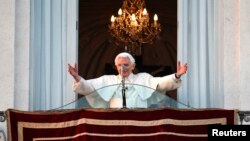
Pope Benedict waves to the faithful from the balcony of his summer residence in Castel Gandolfo, Feb. 28, 2013.
Pope Benedict XVI has resigned, opening the way for the College of Cardinals to meet in a conclave to elect a new pontiff. While Pope Benedict’s decision to step down is unusual, it is not unprecedented.
Papal experts say there are about 10 popes who resigned in the history of the Roman Catholic Church. Before Benedict, the most recent one was Pope Gregory XII who stepped down 600 years ago.
Church historian Chris Bellitto at Kean University in Union, New Jersey said that was at the time of the Catholic Church’s worst institutional crisis, the so-called Great Western Schism, when there were three popes: Gregory in Rome, another one in Avignon, France and a third one essentially traveling around northern Italy.
“And it’s not just three popes - it’s three papacies, it’s three colleges of Cardinals. And so a council called the Council of Constance solved the problem by deposing two of the popes,” said Bellitto. “And then this Gregory XII, he really metaphorically fell on his sword because he probably had the best legal claim, but he knew that you depose two and keep one, it was just not going to work. So he resigned and agreed that he would not be a candidate in the following conclave.”
13th century Pope Celestine V voluntarily resigned
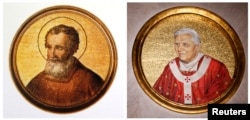
A combination picture of mosaics depicting Saint Celestine V (L) and Pope Benedict XVI taken Feb. 11, 2013.
The best known pope who resigned voluntarily was Celestine V who in the 13th century, before becoming pontiff, was a hermit living in central Italy.
Theology professor George Ferzoco at Bristol University in England said he was a compromise choice since none of the cardinals could agree who should be pope.
He said, “It must have been quite a sight: he would have seen the king of the kingdom of Naples and his retinue along with several of the cardinals coming along with their retinues, coming up this very, very steep, rugged path to his hermitage - and announcing to him that guess what? You are the next pope. It is without parallel in the history of the papacy.”
But Ferzoco said Celestine V’s papacy was short-lived. “He was elected in July of 1294 and by the time December of that year came around, he was fully cognizant of the fact that he was, A: doing a terrible job, and B: hating every second of it, and the latter aspect in particular was fundamental to him,” said Ferzoco. “He passed a law for the church stating explicitly that it was licit [lawful] for a pope to resign under certain circumstances - and the very next day, he resigned. That was the 13th of December 1294.”
Ferzoco said for the last year and a half of his life, Celestine was under house arrest in the castle of his successor as pope. He died on May 19, 1296 and his remains are in a glass coffin in a basilica in the town of L’Aquila.
Pope Benedict Visits Celestine's Coffin
More than 700 years later, in April 2009, Pope Benedict visited L’Aquila, which was hit by a devastating earthquake.
George Ferzoco says during his visit, the pontiff went to Celestine’s coffin, which was not damaged by the earthquake.
“After praying for some time at the coffin that contains Celestine’s body, Benedict did something that was incredibly symbolic and gave a sign as to what may well have been on his mind,” said Ferzoco. “He removed from around his neck a kind of scarf called the pallium. And the pallium is one of the great indicators or symbols of the power of the pope. And what he did was, on removing this pallium, he placed it on the casket containing Celestine’s body - and left it there.”
Ferzoco said many papal scholars missed the unmistakable signs.
“It’s pretty obvious, when you see this and note that he visited Celestine’s remains twice in the space of a year or so. If he had not already been thinking about resigning, this certainly would have got him started. And perhaps it’s not a coincidence that he resigned at about the same age as Celestine.”
Benedict will now hold the title of “Pope Emeritus.” For the next several months he will reside in Castel Gandolfo, the popes’ summer residence. He will then move inside the Vatican, to a convent that is being refurbished.
Andre de Nesnera is senior analyst at the Voice of America, where he has reported on international affairs for more than three decades. Now serving in Washington D.C., he was previously senior European correspondent based in London, established VOA’s Geneva bureau in 1984 and in 1989 was the first VOA correspondent permanently accredited in the Soviet Union.