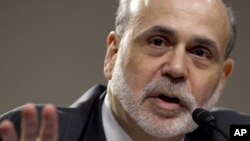
U.S. Federal Reserve Chairman Ben Bernanke says the U.S. economic recovery has slowed and it will take a "frustratingly" long time to cut the unemployment rate.
The head of the U.S. central bank spoke at a congressional hearing Tuesday after reports showed inflation to be relatively mild, while job growth and retail sales were disappointing.
Bernanke said Europe's economy is under "significant stress" which is spilling over to the rest of the world, including the United States.
He said the U.S. economy could also be hurt if Congress and the president fail to reach agreements on tax and spending issues before the end of this year. He again urged Congress to cut spending, but at a slow enough pace to avoid hurting growth while the U.S. economy is in a fragile state.
"The most effective way that the Congress could help to support the economy right now would be to work to address the nation's fiscal challenges in a way that takes into account both the need for long-run sustainability and the fragility of the recovery. Doing so earlier rather than later would help reduce uncertainty and boost household and business confidence," he said.
Related video by Mil Arcega
In the meantime, Bernanke said the Fed is ready to take further action to bolster growth if needed.
The Fed has already cut interest rates to nearly zero and used a complex process of bond purchases in another effort to stimulate the economy.
Senators also questioned Bernanke about a scandal over the way a critical global interest rate, called the LIBOR, was set.
Barclays bank recently paid a fine of around $450 million to the U.S. and British governments after the bank gave false information to the British official who sets the rate each day.
It was an effort to make Barclays look stronger than it was during the financial crisis.
Bernanke said Fed officials in New York became aware of allegations during the financial crisis and reported the matter to British regulatory officials.
The head of the U.S. central bank spoke at a congressional hearing Tuesday after reports showed inflation to be relatively mild, while job growth and retail sales were disappointing.
Bernanke said Europe's economy is under "significant stress" which is spilling over to the rest of the world, including the United States.
He said the U.S. economy could also be hurt if Congress and the president fail to reach agreements on tax and spending issues before the end of this year. He again urged Congress to cut spending, but at a slow enough pace to avoid hurting growth while the U.S. economy is in a fragile state.
"The most effective way that the Congress could help to support the economy right now would be to work to address the nation's fiscal challenges in a way that takes into account both the need for long-run sustainability and the fragility of the recovery. Doing so earlier rather than later would help reduce uncertainty and boost household and business confidence," he said.
Related video by Mil Arcega
In the meantime, Bernanke said the Fed is ready to take further action to bolster growth if needed.
The Fed has already cut interest rates to nearly zero and used a complex process of bond purchases in another effort to stimulate the economy.
Senators also questioned Bernanke about a scandal over the way a critical global interest rate, called the LIBOR, was set.
Barclays bank recently paid a fine of around $450 million to the U.S. and British governments after the bank gave false information to the British official who sets the rate each day.
It was an effort to make Barclays look stronger than it was during the financial crisis.
Bernanke said Fed officials in New York became aware of allegations during the financial crisis and reported the matter to British regulatory officials.
Some information for this report was provided by AP and AFP.