


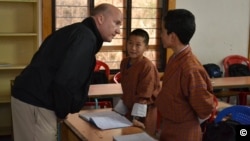
One of the world’s youngest democracy is being helped by journalism professors from a U.S. university.
The Kingdom of Bhutan, at the eastern end of the Himalayas and wedged between China and India, has been a constitutional monarchy for only about four years.
The move from absolute to constitutional monarchy has meant a transition from many centuries of practices, not the least of which was to a free and uncontrolled news media.
The Bhutan Centre for Media and Democracy, a non-government organization, was established to help facilitate that transition.
To help with the project, the organization established a partnership with the Center for News Literacy at Stony Brook University in the eastern U.S. state of New York.
“They asked us to come and teach a workshop for teachers,” said Dean Miller, director of Stony Brook’s Center for News Literacy. The workshop was held this past spring. It was the first of three workshops, with the goal of integrating some of what is done at Stony Brook into, he said, “appropriate, culturally, re-contextualized lessons for Bhutan.”
“The state of the news media right now in Bhutan is rapid growth, both in skills and availability,” said Miller. The number of newspapers and radio stations, he says, has rapidly increased. However “some Bhutanese citizens are taken aback by how critical all of this reporting is,” he said. Miller says for almost all involved, it has become a process of education that “it is the purpose of the fourth estate is to be the watchdog of the second and third.”
The purpose of the project is “not media criticism,” said Miller. “It is more in the line of advocacy for the people who rely on the news, for citizens” he said.
He added the ultimate goal of journalism in a democracy is whether or not citizens can find information on which they can take action as well as how to find information on when they should not take action.
“Solid and reliable journalism is the oxygen of democracy,” said Miller.
“Solid and reliable journalism is the oxygen of democracy,” said Miller.
If funding continues, the project will continue next year when the plan calls for U.S. students, including some high school students, to travel to Bhutan.