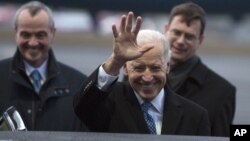
U.S. Vice President Joe Biden has warned Iran that time is running out for a diplomatic resolution of the conflict over its nuclear program.
Biden's comments were published Friday in a German newspaper as he began a visit to Germany to attend a security conference in Munich.
The U.S. vice president said there is time and space for diplomacy and economic pressure on Iran, but he said that opportunity will not be available forever. He said Iran can expect continued sanctions and increasing international pressure.
Iran insists it is pursuing nuclear technology for peaceful means, while the U.S. and its Western allies believe Tehran aims to develop weapons.
This is Biden's first trip overseas since the Obama administration's second term started January 20. He arrived in Berlin Friday for talks with German Chancellor Angela Merkel. They are expected to focus on Syria, but their conversations also are likely to cover the global economy, Afghanistan and Iran's nuclear program.
On Saturday, Biden will deliver a speech at the 49th Munich Security Conference, a forum he addressed four years ago. U.S. officials say that on the sidelines of the conference, he will hold a series of bilateral talks, including with Russian Foreign Minister Sergei Lavrov. Officials also say the vice president will ask Lavrov for a clearer statement on Russia's position on Syria.
Russia is an ally of Syria. Russia and China three times have vetoed resolutions obstructing United Nations Security Council action on Syria, garnering international criticism for shielding President Bashar al-Assad's regime.
Biden is also scheduled to hold bilateral meetings in Munich with the U.N.-Arab League envoy for Syria, Lakhdar Brahimi - who has warned that Syria "is being destroyed" - and with Moaz al-Khatib, the president of the Syrian Opposition Council.
Similar discussions are expected next week when the vice president travels to Paris to meet with French President Francois Hollande, and London for talks with British Prime Minister David Cameron and Deputy Prime Minister Nick Clegg.
The United Nations has appealed for $1.5 billion to assist 5 million people inside and outside of Syria for the next six months. This week, the United States announced it will give $155 million in new aid to Syria to help meet urgent humanitarian needs. The United Nations estimates the nearly two-year-old conflict in Syria has left more than 60,000 people dead.
Biden's comments were published Friday in a German newspaper as he began a visit to Germany to attend a security conference in Munich.
The U.S. vice president said there is time and space for diplomacy and economic pressure on Iran, but he said that opportunity will not be available forever. He said Iran can expect continued sanctions and increasing international pressure.
Iran insists it is pursuing nuclear technology for peaceful means, while the U.S. and its Western allies believe Tehran aims to develop weapons.
This is Biden's first trip overseas since the Obama administration's second term started January 20. He arrived in Berlin Friday for talks with German Chancellor Angela Merkel. They are expected to focus on Syria, but their conversations also are likely to cover the global economy, Afghanistan and Iran's nuclear program.
On Saturday, Biden will deliver a speech at the 49th Munich Security Conference, a forum he addressed four years ago. U.S. officials say that on the sidelines of the conference, he will hold a series of bilateral talks, including with Russian Foreign Minister Sergei Lavrov. Officials also say the vice president will ask Lavrov for a clearer statement on Russia's position on Syria.
Russia is an ally of Syria. Russia and China three times have vetoed resolutions obstructing United Nations Security Council action on Syria, garnering international criticism for shielding President Bashar al-Assad's regime.
Biden is also scheduled to hold bilateral meetings in Munich with the U.N.-Arab League envoy for Syria, Lakhdar Brahimi - who has warned that Syria "is being destroyed" - and with Moaz al-Khatib, the president of the Syrian Opposition Council.
Similar discussions are expected next week when the vice president travels to Paris to meet with French President Francois Hollande, and London for talks with British Prime Minister David Cameron and Deputy Prime Minister Nick Clegg.
The United Nations has appealed for $1.5 billion to assist 5 million people inside and outside of Syria for the next six months. This week, the United States announced it will give $155 million in new aid to Syria to help meet urgent humanitarian needs. The United Nations estimates the nearly two-year-old conflict in Syria has left more than 60,000 people dead.