


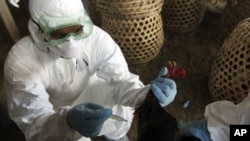
An international group of scientists has lifted its year-long moratorium on studying the highly infectious H5N1 bird flu virus. Scientists said Wednesday the medical benefits of their research far outweigh the potential risk of public harm, but many of them might still have to wait for the United States to resume funding their controversial research.
Japanese virologist Yoshihiro Kawaoka of the University of Tokyo told reporters he and 40 other signatories to a bird-flu research moratorium last year plan to resume their work to learn more about the H5N1 avian influenza virus, with the goal of preventing a potentially lethal human pandemic.
“Therefore the greater risk is not doing research that could help us be better equipped to deal with a pandemic," he said.
Public fears peaked a little over a year ago that highly pathogenic, mutated copies of the H5N1 virus could escape from research laboratories and sicken the public, or be stolen and weaponized by bio-terrorists, leading to a global public health emergency. At the request of the U.S government, Kawaoka and researcher Ron Fourchier of Erasmus Medical Center in Rotterdam, Netherlands, agreed to temporarily halt their H5N1 research, and to limit publication of their findings to date.
U.S. officials asked that key details of the scientists’ research on the transmissibility of mutant strains of the virus in ferrets be omitted in studies slated for publication in the journals Nature and Science, until the lab security risks and oversight measures could be further studied.
After a year of investigating the safety of H5N1 research in several countries, and being satisfied that the research poses little or no public harm, the scientists say it’s time to move ahead with studies of H5N1. They want to identify viral mutations that could make the bird pathogen more easily transmissible to humans through sneezing or coughing, changes that would raise the danger of a deadly pandemic.
Already, says researcher Ron Fouchier, a number of viral mutations have been discovered in birds in Asia that could help public health officials keep an eye out for the emergence of H5N1 in the human population.
"We have now put these mutations in the context of a virus from Indonesia and Dr. Kawaoka has done in the context of a virus from Vietnam. But there are other genetic lineages of H5N1 in Egypt and China, for instance, that we would like to test whether these viruses will emerge," he said.
Fouchier says the work will also help scientists develop vaccines against H5N1. Besides the Netherlands, he says, China is expected to begin further research with H5N1 in the next few weeks.
But many countries conducting viral research receive their funds from the United States. Anthony Fauci, director of the National Institute of Allergy and Infectious Diseases, says any request for H5N1 funding support will be subject to approval under guidelines for so-called dual use research, in which scientists must demonstrate their research could not be used for nefarious or harmful purposes.
“So even though they, quote, 'lifted the moratorium,' those who are funded by the U.S. government, by the N.I.H., will not proceed with these experiments until they get cleared through the criteria that I just mentioned to you," he said.
Fauci says most countries conducting H5N1 funding get the lion’s share of their funding from the U.S. government, and grants are made based on the National Institutes of Health's determination that the scientific investigation is necessary.
But Ron Fouchier of the Netherlands says many international scientists might be able to secure at least partial funding for renewed H5N1 research from the European Union.