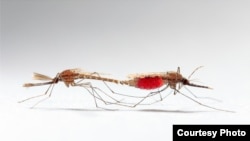
Mating of some disease-carrying mosquitoes would not result in births if scientists can disable the male’s mating plug. (University College London/Sam Cotton)
A team of scientists at Yale University is working on a new birth-control drug for male mosquitos that could slow the malaria epidemic, a disease that sickens more than 215 million people, killing 655,000 each year.
Only female Anopheles gambiae mosquitos transmit malaria to humans and they are the principle vector for the disease. But chemistry professor Richard Baxter and his team at Yale University are focused on the males.
Malaria mosquitos mate in airborne swarms. Unlike any other insect, the male inserts a gooey plug to seal its sperm inside the female during mating to ensure reproductive success.
At a meeting of the American Chemical Society in Philadelphia this week, Baxter and his colleagues announced a new approach for screening chemical compounds that would inhibit formation of the mating plug.
This sterile insect technique has been successfully deployed in Africa against tsetse flies that transmit sleeping sickness, and in the United States to control the screwworm fly, which was once responsible for millions of dollars in losses in the cattle industry and has since been eradicated.
Two boys sit under a net in Patigo, Papua New Guinea in this file photo. While indoor spraying and insecticide treated bed nets have been important tools for malaria control, mosquitos are becoming resistant to such measures.
Baxter says this is important because malaria mosquitos are becoming resistant to insecticides and adapting to indoor control measures by biting outdoors, during the day.
“So the idea is if we can actually suppress the mosquito, we will prevent the transmission of the disease and then eventually if you prevent transmission for several seasons, you will eradicate the parasite that itself causes the disease without eradicating the mosquito.”
Over the next several months, Baxter will test various chemicals to see which ones disable the proteins, so mating would be unsuccessful.
“If that works in the lab, then we can move on to semi-field trails, where we have a large cage, which is outdoors," he says. "That would test the efficacy of the compound in a more realistic setting.”
After mosquitos are fed the inhibiting compound, the modified males would be released to mate with wild females. With no resulting offspring, the population would be reduced without the use of pesticides.