



The reputation of blueberries as a so-called "super-food" has created a boom in South Korea. People here are increasingly consuming the vitamin-rich fruit because of research contending blueberries may help ward off cancer, heart disease, strokes, infections, and other ailments. The berries were virtually unseen on the Korean peninsula until just a few years ago, but that has changed.
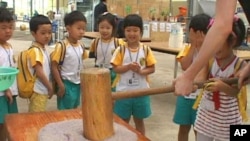
Summer camp kids get a hand with an old Asian tradition, with a twist - pounding rice cakes infused with blueberry juice.
South Koreans, who had rarely sampled blueberries a decade ago, now cannot seem to get enough of them. Juices and jams, touted for their anti-oxidant properties, fly off the shelves. The 1,500 tons of blueberries harvested this year on 1,000 South Korean farms are not enough to meet demand.
At the Korea Blueberry Exposition, visitor Song Yong-jun credits a mass-produced pastry for starting the berry boom.
"A confectionary company launched blueberry pies a few years back," he recalled. "It gained quite a bit of popularity even though blueberries weren't well known at the time. I think that's when people became interested in blueberries. That prompted the launch of other products, such as blueberry-flavored chewing gum."
Blueberry farming began several years ago with seedlings from neighbor Japan.
Yu Dongsool, an advisor at the Agriculture Human Resources Development Institute, says the shrub thrives in moist, acidic conditions, such as swamps or bogs. So it needs a little help to flourish in South Korea.
"We have to import peat moss from overseas. In Korea, we have an acidic soil with a PH level similar to that found in swamps," he noted. "The nutrient-rich peat moss and our efficient water-draining Korean soil together make an excellent combination for cultivating blueberries."
This small fruit is fetching a hefty price in the marketplace, retailing for about $50 per kilogram in department stores. And that is fueling increased interest by farmers. Industry officials predict that by next year the number of farms growing blueberries in Korea will increase 300 to 500 percent.
"I am certain that Korean people's interest in blueberries is not a fad, but rather blueberry consumption will continue to grow and blueberries will be loved by Koreans even more," he added.
South Korea is considering allowing imports of fresh blueberries from Chile, and the United States to help satisfy the nation's appetite for the fruit.