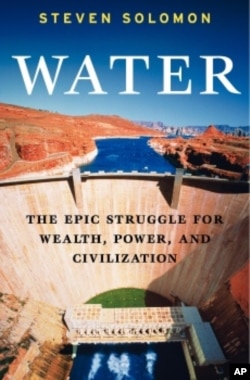
Steven Solomon's new book, "Water: the Epic Struggle for Wealth, Power and Civilization", is a comprehensive look at how societies through the ages have organized around this vital and often scarce resource.
Revolutionary advances
Solomon describes transformative inventions like the waterwheel, irrigation, the steam engine and hydro-electric power.
He says some of these innovations are actually at the root of today's worsening water scarcity problems, starting with the Hoover Dam, which transformed America's arid west.
"There are 45,000 such multipurpose dams around the world, half of them, by the way, in China. They were one of the facilitators of the Green Revolution, because the Green Revolution was not just a matter of hybridization of cropping and fertilization, but needed massive amounts of water."
Water use grew twice as fast as the world population in the 20th century, Solomon says, but today our ability to exploit water can no longer match the demand. "We simply don't have enough water to do the economic things that we need to do with it or want to do with it for 6.5 billion, much less the 9 billion [people] that we are becoming."
According to the United Nations, one billion people around the world lack access to safe drinking water and 2.5 billion people lack adequate sanitation.
Water inequity
Poorer nations are the hardest hit, with an enormous gap between the haves and have-nots.
Solomon says he saw this inequity clearly during his 2004 visit to a rural village in southeastern Kenya, where he'd gone as a volunteer to help build a simple mud dam needed to trap monsoonal water for cattle.
"It's back-breaking laborious effort that takes a great amount of time and effort. These people are living at dirt poor subsistence level, largely because they have not had the means to be able to manage the water resources that they do have."
Another service project on that same trip, helped connect villagers in the region with a well that had been drilled thirty years earlier. Prior to its completion, people in the area had to carry water more than three kilometers for their daily needs.
"It takes up many hours, time that you can't use for education for education for the kids, for productive work. It's a form of enslavement really given the technologies that are available to us today to be able to deliver water."
Hot spots
Solomon's book also examines the world's water hot spots - countries such as India and China, where water scarcity could limit those nations' capacity to feed themselves.
Solomon examines the intense competition in East Africa over Nile River water and describes how essential underground aquifers in North Africa and the Middle East are drained faster than they are replenished.
Fresh water, Solomon explains, is simply disappearing in many parts of the world. More and more rivers, slowed by dams and bled by irrigation canals, don't reach the sea anymore. Wetlands are disappearing. And clean drinking water, traditionally drawn from rivers or wells, is becoming increasingly scarce or unavailable.
Delicate balance
Solomon is guardedly hopeful that these trends can be reversed if societies learn to use water more efficiently and if they adhere to three broad principles, the first and foremost being social equity.
"Ecosystems need to be managed in a sustainable manner and that water needs to be treated as an economic good."
Solomon believes ending fresh water scarcities will require nations to work together to devise new domestic and foreign policies that protect and share this critical resource.
"How each country acts in response to the freshwater crisis…is a judgment on our own humanity and the ultimate fate of human civilization," he says.
"Water: the Epic Struggle for Wealth, Power and Civilization," by Steven Solomon, is published by Harper Collins.