


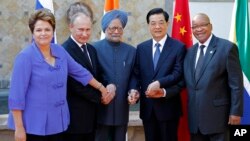
The cornerstone achievement of this year’s BRICS summit is expected to be the foundation of a development bank. The group, which includes Brazil, Russia, India, China and South Africa, hopes the money can be used to fund infrastructure, but experts say it may take years to develop the bank.
Officials from the five nations have been meeting regularly to discuss details behind this development bank ahead of the summit in Durban, South Africa later this month.
The BRICS nations are rapidly emerging economies that feel they do not get enough say on the world stage. Despite their economic clout, none has led the International Monetary Fund or the World Bank. And India, Brazil and South Africa have all lobbied for a permanent seat on the U.N. Security Council, to no avail.
South Africa’s ambassador to BRICS, Anil Sooklal, says the group is a way of offsetting that historical imbalance by giving each nation a say in the bank.
“One thing is very clear amongst the BRICS member states: that this bank will be collectively owned by all the BRICS countries, and it is not going to be a bank dominated by any one BRICS country. That is very clear,” Sooklal stressed.
But little is known about the dollars and cents of this proposed financial institution - where it will be based, when it will open, who will receive loans, or even what currency it will use. Those details are to be finalized at an upcoming summit.
Africa financial services director for consulting firm Ernst and Young, Emilio Pera, says although many of the particulars are yet to be ironed out, the bank is a good idea.
“I believe the proposed BRICS-led bank is a very positive development for South Africa and for the the wider Southern Africa," Sooklal explained. "It provides the opportunity to mobilize funding for infrastructure development, which is needed in most emerging markets, and in particular in South Africa at present, and which would benefit the wider region as well. It also strengthens the cooperation between the BRICS countries.”
A recent report from South Africa’s Standard Bank says each of the five nations is expected to contribute $10 billion. In contrast to the IMF and the World Bank, where members contribute relative to the size of their economy and get a share of votes based on that.
But the Standard Bank analysts have asked whether that will lead to a power imbalance. China’s economy on its own is bigger than that of the four other nations combined. For China, $10 billion is not a lot of money, it is less than one-eighth of one percent of its gross domestic product. But for South Africa, the smallest BRICS economy, it is a hefty bill - nearly half of the nation’s education budget.
One of the Standard Bank analysts, Simon Freemantle, says it could be a long time before the bank starts working.
“I think the bank itself has a long process through which it still has to travel in order for it to reach the point where it can extend loans... But I do not anticipate the formal structural origination of the bank will result immediately from next week’s summit. So I think it will be some time before they have the capacity to extend loans.”
Officials from the five nations have been meeting regularly to discuss details behind this development bank ahead of the summit in Durban, South Africa later this month.
The BRICS nations are rapidly emerging economies that feel they do not get enough say on the world stage. Despite their economic clout, none has led the International Monetary Fund or the World Bank. And India, Brazil and South Africa have all lobbied for a permanent seat on the U.N. Security Council, to no avail.
BRICS Factbox
BRICS- The world's five largest emerging economies: Brazil, Russia, India, China, South Africa
- Total population of BRICS nations is almost 3 billion people
- Total BRICS GDP is $14 trillion
- The fifth annual BRICS summit starts March 26 in Durban, South Africa
“One thing is very clear amongst the BRICS member states: that this bank will be collectively owned by all the BRICS countries, and it is not going to be a bank dominated by any one BRICS country. That is very clear,” Sooklal stressed.
But little is known about the dollars and cents of this proposed financial institution - where it will be based, when it will open, who will receive loans, or even what currency it will use. Those details are to be finalized at an upcoming summit.
Africa financial services director for consulting firm Ernst and Young, Emilio Pera, says although many of the particulars are yet to be ironed out, the bank is a good idea.
“I believe the proposed BRICS-led bank is a very positive development for South Africa and for the the wider Southern Africa," Sooklal explained. "It provides the opportunity to mobilize funding for infrastructure development, which is needed in most emerging markets, and in particular in South Africa at present, and which would benefit the wider region as well. It also strengthens the cooperation between the BRICS countries.”
A recent report from South Africa’s Standard Bank says each of the five nations is expected to contribute $10 billion. In contrast to the IMF and the World Bank, where members contribute relative to the size of their economy and get a share of votes based on that.
But the Standard Bank analysts have asked whether that will lead to a power imbalance. China’s economy on its own is bigger than that of the four other nations combined. For China, $10 billion is not a lot of money, it is less than one-eighth of one percent of its gross domestic product. But for South Africa, the smallest BRICS economy, it is a hefty bill - nearly half of the nation’s education budget.
One of the Standard Bank analysts, Simon Freemantle, says it could be a long time before the bank starts working.
“I think the bank itself has a long process through which it still has to travel in order for it to reach the point where it can extend loans... But I do not anticipate the formal structural origination of the bank will result immediately from next week’s summit. So I think it will be some time before they have the capacity to extend loans.”